
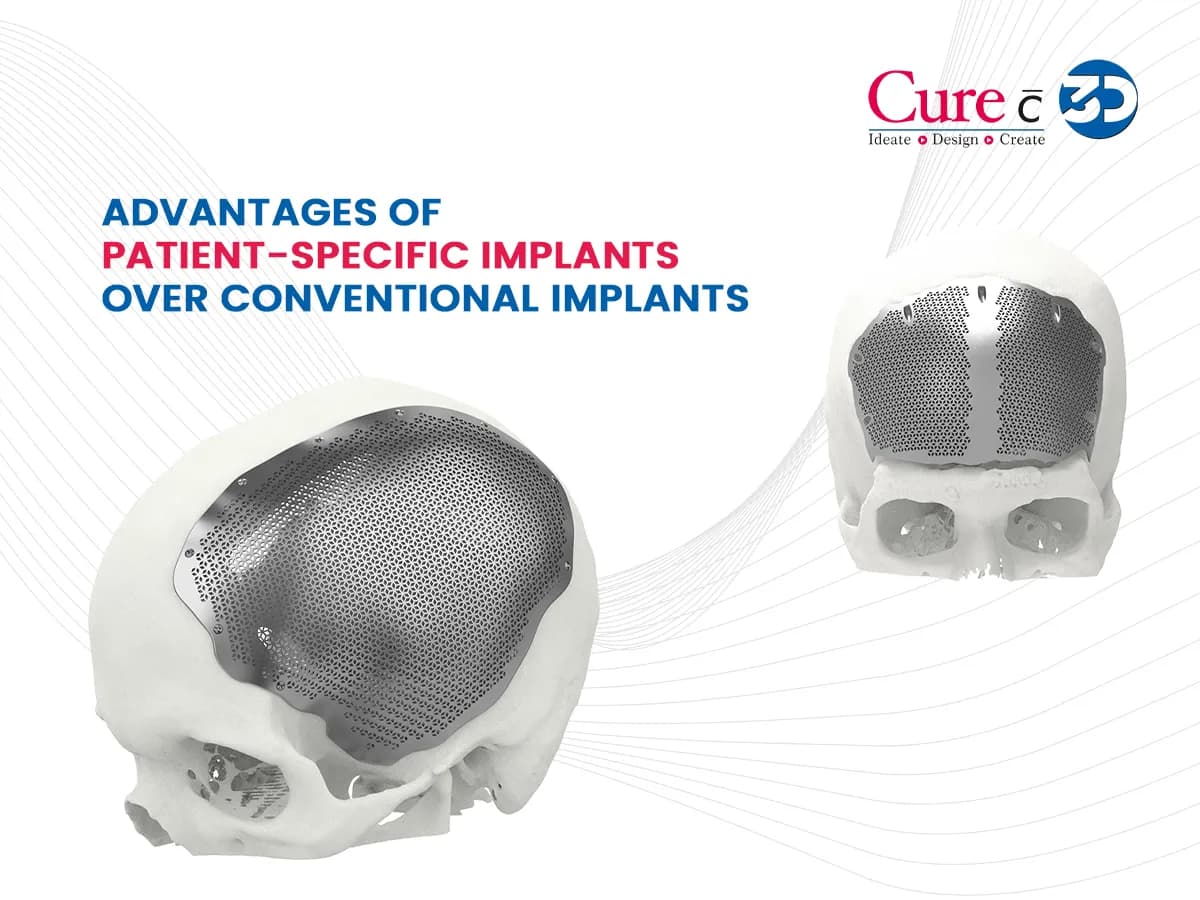
Advantages of Patient-Specific Implants over Conventional
Over 30 million orthopedic procedures occur worldwide each year, with millions involving implants like hip and knee replacements.
Every single one of those implants decides how a patient walks, moves, heals, and lives next. yet 5-10% require revision surgeries due to issues like poor integration or loosening.
What if the implant actually matched the patient — instead of forcing the patient to match the implant?
That single question gives birth to the idea of patient specific implants.
For decades, surgeons worked with conventional implants. They worked — no doubt. But human bodies are not of “standard sizes.” Everyone’s bones vary by shape, orientation, trauma patterns, tumor loss, deformities, and previous surgeries, etc.
Today, with advances like 3D printed patient specific implants, surgeons have something better — implants that are planned, modeled, and produced for one patient, one anatomy, one surgery.
But then,
Why Ordinary Implants Struggle in Complex Anatomy?
Conventional implants come in fixed shapes and limited sizes. Surgeons often need to adjust bone cuts, modify soft tissue, and compromise on alignment to “fit” the implant.
That leads to common issues:
- Mismatch between implant and bone geometry
- Longer operating time
- Bone loss due to extra trimming
- Revision risk in deformity, tumor, and trauma cases
Think about this scenario, where patient with osteosarcoma loses a part of the femur. A standard implant cannot simply “fill” the missing section with perfect accuracy. That means more reconstruction steps, more improvisation, and sometimes, a higher chance of complications.
This is exactly where patient specific implants step in as a smart, science-backed upgrade.
The Upgrade: Patient-Specific Implants
Patient specific implants are devices designed directly from a patient’s CT or MRI scan. Engineers and surgeons work together to plan the shape, size, fixation points, and mechanical strength — specifically for that patient.
Most modern patient specific implants 3D printing, especially when bone shapes are complex.
Key features:
- Customized geometry based on patient scans
- Perfect fit with surrounding bone
- Controlled weight and porosity
- Better anatomical alignment
- Reduced need for bone modification
They are widely used in:
- Orthopedic oncology
- Revision surgeries
- Complex deformities
- Oral & Cranio-maxillofacial reconstruction
- Trauma with bone loss
How Patient-Specific Implants Are Created (Step-by-Step)
This is where technology meets surgery — and it feels almost futuristic.
From Scan to Surgery: The Workflow
| Stage | What Happens | Benefit |
| 1. Imaging | High-resolution CT/MRI of the affected region | Accurate 3D model of patient anatomy |
| 2. Virtual Planning | Engineers and surgeons co-plan the implant digitally | Predictable surgical plan |
| 3. Implant Design | Custom implant modeled around exact bone structure | Perfect anatomical fit |
| 4. 3D Printing | Titanium or PEEK implant printed layer by layer | High precision and biocompatibility |
| 5. Pre-Surgical Trial | Virtual trial or printed trial implant used | Confidence before the actual surgery |
| 6. Final Implant Sterilization | Ready for OT | Safe and ready to implant |
This process allows orthopedic implants manufacturers, such as Curewith3D to support surgeons with implants that align exactly with surgical goals.
Does Patient-Specific Implants Outperform Conventional Ones?
Indeed.
- Better Fit — Less Guesswork
With standard implants, surgeons adjust during surgery. With patient-specific implants, planning happens before entering the operating room.
Benefits:
- Less bone cutting
- More stable fixation
- Natural joint alignment
- Lower risk of post-operative pain
- Shorter Surgery Time
Because patient specific implants come pre-planned, surgeons spend less time reshaping bone or selecting sizes.
This can reduce:
- Blood loss
- Infection risk
- OT fatigue
- Improved Load Distribution
Patient specific Implants designed around anatomy help distribute body weight evenly. That supports healing and lowers stress on surrounding tissues.
- Lower Revision Risk
Conventional implants sometimes fail in complex anatomy. Custom implants fit better, which improves longevity.
- Confidence During Complex Surgeries
Surgeons often describe one major benefit:
They know exactly what they’re going to see before surgery begins.
Virtual surgery planning tools and patient models give clarity and control.
Patient-Specific vs Conventional Implants
| Feature | Conventional Implants | Patient-Specific Implants |
| Fit | Standard sizes | Designed per patient anatomy |
| Bone Cutting | Often more required | Minimal trimming |
| Accuracy | Depends on intra-operative judgement | Digitally planned |
| Surgery Time | Longer | Often shorter |
| Results | Good in routine cases | Excellent in complex anatomy |
| Cost | Lower initially | Better long-term value |
Why 3D Printing Changed Everything?
Earlier, manufacturing fully customized implants was slow and expensive.
With 3D printing, patient-specific implants now implants are now:
- Produced faster
- Built with porous structures that encourage bone growth
- Crafted with high precision
Important facts:
- Titanium 3D-printed patient-specific implants allow bone to grow through micro-porous surfaces.
- PEEK implants offer lightweight stability and compatibility with imaging.
This gives surgeons more options while planning.
Where Surgeons See the Biggest Gains
- Tumor Reconstruction
After removing cancerous bone, reconstructing the defect is challenging.
Patient-specific implants provide:
- Exact defect coverage
- Stable reconstruction
- Better cosmetic and functional outcome
2. Complex Trauma
Irregular fractures and bone loss benefit from implants designed around the defect.
3. Revision Surgeries
When old implants fail, bone geometry changes. Custom implants fill voids accurately and restore balance.
4. Congenital and Post-Infection Deformities
These cases rarely fit standard implants. Patient specific designs adapt naturally.
A Problem-SolvingView: What Patients Actually Experience
Patients don’t always understand engineering terms. They simply nPatients don’t always understand engineering terms. They simply notice:
- They can move more comfortably
- Their implant feels “natural”
- Fewer hospital visits for complications
- Faster return to daily activities
Surgeons, meanwhile, get predictable results and controlled planning — which reduces surgical stress.
Role of Implant Manufacturers in This Shift
The rise of patient specific implant technology has reshaped Submit Medical Imaging (CT/ MRI/ DICOM files)
→ →
Virtual Surgery Planning
→ →
Approval from Surgeon
→ →
3D Printing the implant
→ →
Quality Verification
→ →
Receive your custom 3d printed implant
Orthopedic implants manufacturers increasingly operate through:
Design teams
- Biomedical engineers
- Software planning platforms
- Rapid prototyping labs
The relationship between surgeon and implant manufacturer becomes more like a partnership focused on better pateint outcomes.
Challenges That Still Exist (And How They Are Improving)
A real conversation must also acknowledge areas that need progress:
- Access in smaller hospitals
- Training and awareness
- Up-front cost perception
- Dependence on imaging quality
Future of Patient-Specific Implants
We are moving toward:
- Virtual surgical planning
- Patient specific implants from smart biocompatible material
- Faster manufacturing cycles
As more outcomes data emerges, patient-specific technology may soon become a standard choice — not a special request.
Key Takeaways
- Patient specific implants respect patient’s unique anatomy instead of forcing anatomy to adjust.
- 3D printing allows precision, stability, and better mechanical behavior.
- Surgeons gain predictability, accuracy, and control during surgery.
- Patients experience better comfort, mobility, and quality of life.
- Orthopedic implants manufacturers are becoming innovation partners, not just suppliers.
The future of implants isn’t about “one size fits all.”
It’s about the right implant for the right patient — every single time.
References: