
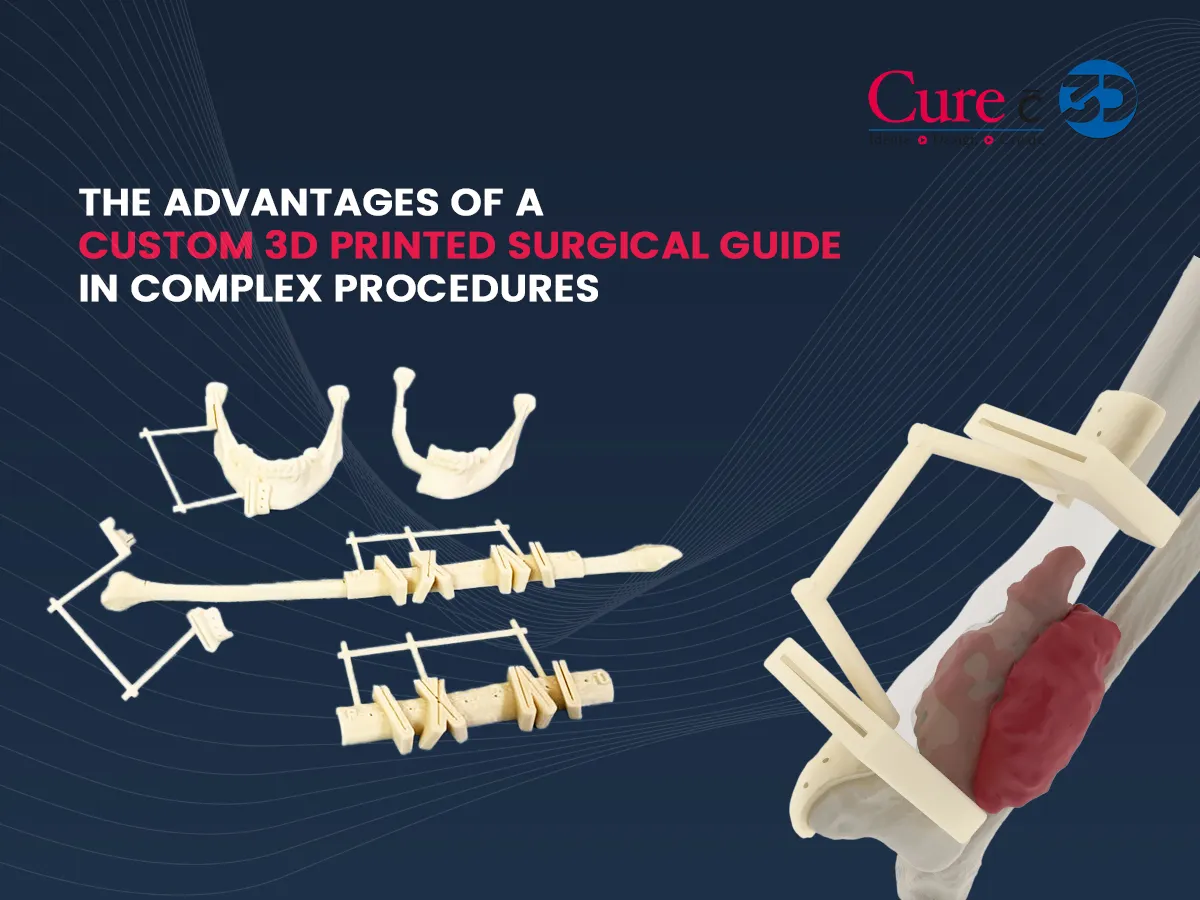
The Advantages of a Custom 3D Printed Surgical Guide in Complex Procedures
In today’s world, the rising number of road traffic accidents, maxillofacial trauma, and advanced dental and orthopedic conditions has led to a growing demand for complex surgical procedures, where precision is critical and traditional methods often fall short. At this critical juncture, the importance of a custom 3D printed surgical guide comes into focus. Recent studies show that use of these guides can improve surgical accuracy by up to 97%, reduce operating time by as much as 20–30%, and significantly lower complication rates compared to traditional freehand techniques. These innovative surgical guides, tailored to each patient’s unique anatomy, are redefining how surgeons approach challenging cases—from intricate facial reconstructions to complex oral and maxillofacial interventions.
Among their most transformative applications are dental implant surgery, 3D dental implants, and advanced implant placements such as the Zygoma implant. With a custom 3D printed surgical guide, clinicians can navigate complex anatomy with greater confidence, planning precision, and intraoperative efficiency. The result? Enhanced patient outcomes, shorter recovery times, and predictable surgical excellence.
What Is a Custom 3D Printed Surgical Guide?
A custom 3D printed surgical guide is a patient-specific tool created from high-resolution imaging data (like CBCT or CT scans) and advanced 3D modeling. During surgery, it directs drills and implants with pinpoint accuracy—minimizing guesswork and anatomical risk.
Unlike generic guides, custom surgical guides are designed for each individual’s anatomy, offering tailored support in even the most challenging cases. This personalized approach is especially beneficial in procedures involving 3D dental implants and Zygoma implants, where anatomical variation can significantly impact outcomes.
How Does a Custom Surgical Guide Benefit Surgeons, Patients & Medical Students?
Higher Surgical Accuracy
Clinical procedures consistently demonstrate improved placement precision, with angular deviation typically limited to approximately 2–3 degrees from the pre-planned trajectory.
Shorter Operative Time
Research across orthopedic and maxillofacial surgeries shows an average time saving of 23 minutes per case when surgical guides are used, increasing to up to 62 minutes with the support of anatomical models. Overall, 46% of studies report a measurable reduction in operating room time.
Lower Risk of Complications
In complex spinal surgeries, the use of surgical guides has been shown to significantly reduce pedicle cortex perforation rates, with incidences dropping to as low as 0.5%.
Reduced Radiation Exposure
Compared to freehand techniques and certain navigation systems, guided procedures often require fewer intraoperative X-rays, lowering radiation exposure for both patients and surgical teams.
Enhanced Learning and Surgical Understanding
In training and educational environments, studies consistently report improvements in knowledge retention, spatial understanding, and examination performance when surgical guides are incorporated.
How Custom 3D Printed Guides are Transforming Surgical Procedures & Patient Experience?
Enhanced Precision and Accuracy
One of the biggest advantages of a custom 3D-printed surgical guide is its precision. Studies consistently show that these guides:
- Reduce angular deviations during drilling by over 60–70%
- Limit positional deviation to under 1 mm in implant placement
- Improve placement accuracy compared to freehand techniques
In dental implant surgery, these improvements mean better alignment with planned prosthetics, fewer adjustments, and higher implant success rates. For Zygoma implants, where the implant is anchored in the dense zygomatic bone to support patients with severe maxillary bone loss, accuracy is crucial—errors can compromise function and esthetics.
Shorter Operating Times and Reduced Risks
Traditional implant placement or complex oral surgery often requires meticulous intraoperative decision-making. Custom 3D printed guides enable surgeons to follow a pre-planned pathway, significantly speeding up the procedure.
Clinical data suggests that when custom guides are used:
- Overall, surgery time can decrease by 20–30%
- Intraoperative complications are reduced
- Less time under anesthesia improves patient safety
In challenging cases such as 3D dental implants in compromised bone quality, these time savings also translate to less intraoperative fatigue for surgeons and improved workflow efficiency.
Predictable Outcomes in Complex Anatomy
Not all surgical cases are straightforward. Anatomical variations like sinus proximity, nerve canals, and bone deficiencies complicate dental implant surgery and Zygoma implant placement.
Custom 3D printed surgical guides enable:
- Accurate avoidance of critical structures like the inferior alveolar nerve
- Complex angulation control for long implants
- Optimal positioning to support prosthetic function
This level of predictability is vital in cases where conventional techniques could lead to misplacement, requiring additional corrective procedures.
Better Patient Experience and Satisfaction
Precision and predictability directly translate into better recovery and patient comfort. Advantages seen in patient outcomes include:
- Reduced postoperative pain
- Lower incidence of swelling and inflammation
- Shorter healing times
- Higher overall satisfaction with esthetic and functional results
In 3D dental implant procedures, improved placement not only enhances functional bite but also supports long-term oral health.
Optimized Prosthetic Integration
In 3D dental implants, especially in full-arch restorations or All-on-X procedures, alignment matters not only for surgery but for the subsequent prosthesis.
Benefits include:
- Better seating of final restorations
- Reduced need for prosthetic adjustment
- Enhanced long-term function and comfort
Custom guides ensure that the implant trajectory supports the final prosthetic design—aligning surgical and prosthetic planning seamlessly.
Surgeon Confidence and Workflow Efficiency
For clinicians, custom 3D printed surgical guides offer more than just technical accuracy—they streamline decision-making.
Key workflow improvements include:
- Pre-surgical visualization and rehearsal
- Integration with digital planning tools
- Reduced intraoperative stress and uncertainty
For busy practices or high-volume surgical centers, this means greater throughput without compromising quality.
Cost-Effectiveness in the Long Run
While custom 3D printed surgical guides require an upfront investment, they offer long-term savings by:
- Reducing the need for revision surgeries
- Minimizing surgical complications
- Shortening operating room time
- Enhancing implant longevity
In dental implant surgery, fewer corrective procedures and greater first-time accuracy translate to cost-savings for both clinicians and patients.
Facilitating Complex Implant Types: Zygoma Implants
Zygoma implants are a prime example of when custom guides are invaluable. These implants are used when the upper jaw (maxilla) has insufficient bone for traditional dental implants, anchoring into the zygomatic bone instead.
Challenges addressed by custom 3D printed guides:
- Navigating steep angles without compromising adjacent structures
- Assuring stable, long-lasting anchorage in dense bone
- Improving surgical confidence in high-risk cases
Without a custom guide, such procedures depend heavily on surgeon experience and intraoperative judgment—introducing variability. With guided placement, outcomes become more reliable and reproducible.
The Future of Precision Surgery
As 3D printing technology continues to advance, custom surgical guides will only become more sophisticated. From improved materials to AI-assisted planning, the next generation of guides will provide even greater support in complex procedures.
Whether you are planning standard implants, 3D dental implants, or advanced placements like Zygoma implants, integrating custom 3D printed surgical guides into your workflow is a leap toward safer, more predictable, and patient-centric surgical care.
Conclusion
The custom 3D printed surgical guide represents a major advancement in surgical precision, efficiency, and patient outcomes—especially in complex cases. By enabling tailored surgical pathways, improving accuracy, and supporting advanced implant techniques such as Zygoma implants and 3D dental implants, these guides are quickly becoming the standard of care.
For clinicians focused on excellence in dental implant surgery, adopting custom 3D printed guides isn’t just a technological upgrade—it’s a clinical necessity.
How A Custom 3D Printed Surgical Guide Helps Surgeons Operate Smarter, Not Longer
The Advantages of A Custom 3D-Printed Surgical Guide in Complex Procedures
From Planning to Precision: The Benefits of Using A Custom 3D-Printed Surgical Guide
How A Custom 3D Printed Surgical Guide Supports Minimally Invasive Surgery