
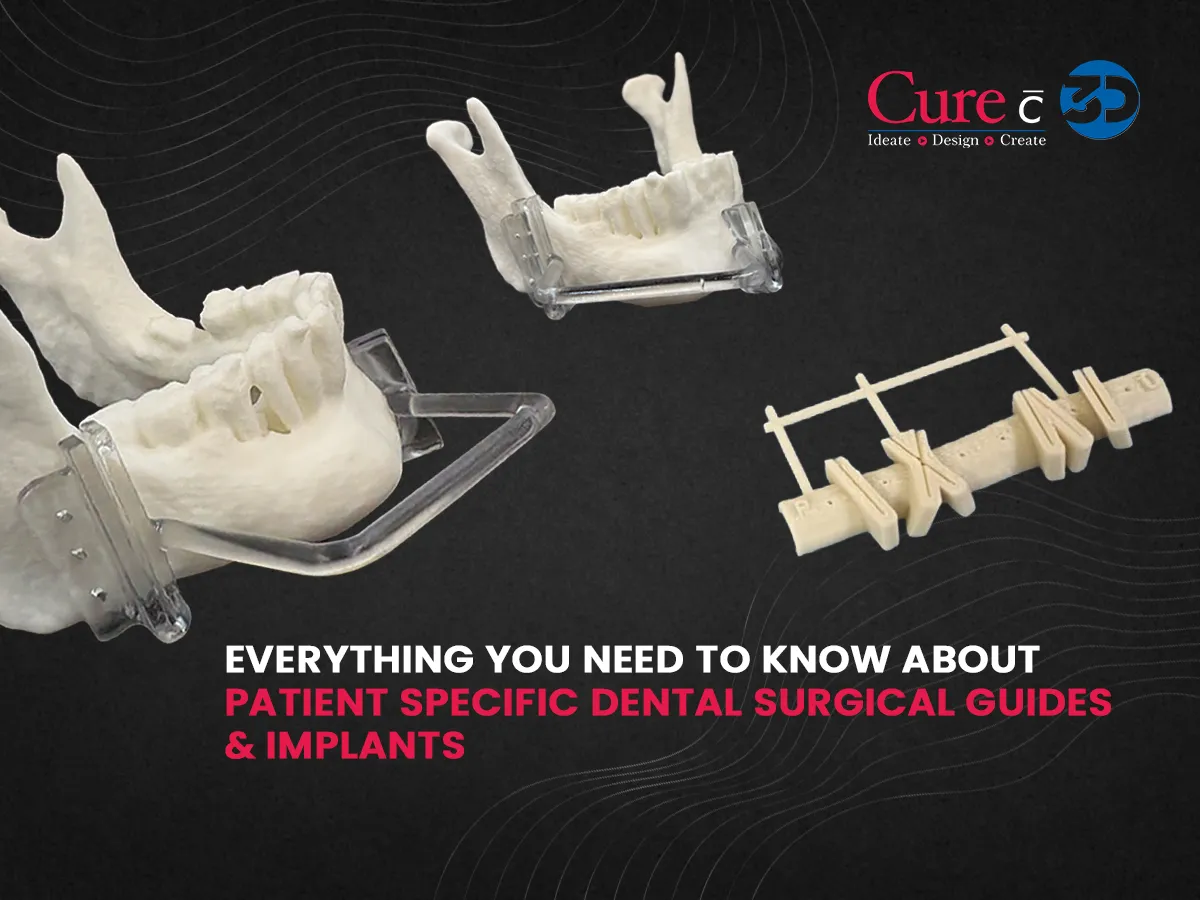
Everything you need to know about Patient Specific Dental Surgical Guides & Implants
“What if dental surgery could feel planned like Google Maps?”
“And what if complex OMF surgeries stop feeling risky and start feeling predictable?”
Sounds like a far-fetched futuristic dream, right?
But now, it’s possible with 3D-printed patient-specific dental surgical guides and implants.
Dentistry today is not just about filling missing teeth. It’s about accuracy, aesthetics, faster recovery, and surgeries that feel calm instead of chaotic. Surgeons and dentists across the globe are shifting from guess-based freehand placement to digitally planned, guided procedures.
Patients love it because the outcomes look natural and closely aligned with their anatomy, and hospitals & surgeons prefer it because accuracy goes up & OT time reduces.
Let’s break it down clearly, step by step.
What exactly are patient-specific dental surgical guides?

Dental surgical guides are like GPS for implant surgery. They are custom -made devices that fit inside a patient’s mouth during surgery and guide the drill in the precise direction, angle, and depth that was preplanned on software.
These guides are designed from the patient’s CT/ MRI scans and then produced as a 3D printed surgical guide.
How they are used during surgery
- The surgical guide is placed in the mouth
- It locks onto teeth, bone, or gums
- The drill follows the guide sleeve path
- The implant is placed exactly as digitally planned
So, no guessing. No wide-angle deviations. Less stress for both surgeon and patient.
Why was there a need for guided dentistry?
Let’s talk about real problems many surgeons face:
- narrow ridges
- irregular bone anatomy
- proximity to nerve or sinus
- limited mouth opening
- aesthetic front, tooth zone
- complex, full arch cases
Freehand drilling in such cases can feel risky. Even a tiny error can lead to major consequences:
| Problem if implant is misaligned | Impact on patient |
| Too shallow or deep | implant failure risk |
| Wrong angulation | crown looks odd |
| Touches sinus or nerve | pain, complications |
| Bad positioning | food lodgment, speech issues |
| Crown does not fit properly | repeated dental visits |
Since, in surgery, accuracy matters, and patient -specific surgical guides make accuracy easier.
How are patient -specific dental guides actually made?
The process is digital and clean. No guesswork.
Step -by-step workflow
- CBCT scan is taken
- Dental impression or intraoral scan is captured
- Software merges both images
- 3D printed patient specific implant positions are virtually planned
- Surgical guide is digitally designed & manufactured in a 3D printed surgical guide
- Sterilization
- Surgery is performed using it
The result? The surgical outcome matches the digital plan closely.
Smart tech behind these guides
Three breakthroughs made this possible:
- CBCT shows bone, nerves, sinus
- CAD software allows virtual implant placement
- 3D printing converts the plan into a physical guide
This digital ecosystem reduces uncertainty and improves confidence.
Types of dental surgical guides
Different cases need different guide supports.
️Tooth -supported guides
- Sit on natural teeth
- Very stable
- Great for partially edentulous cases
Mucosa -supported guides
- Rest on soft tissue
- Common in fully edentulous jaws
- Pins may be used for fixation
Bone -supported guides
- Sit directly on bone
- Used in flap surgeries
- Helpful for full, arch and trauma cases
Each one is customized to that patient ; nothing generic, nothing “one size fits all”.
What about patient-specific implants?
Sometimes, bone anatomy is unusual.
Standard implants do not always fit well in:
- trauma cases
- tumor resections
- congenital deformities
- severe bone loss
This is where patient, specific implants step in.
These are designed exactly as per the patient’s bone and prosthetic plan. They improve fit, function, and aesthetics while reducing reshaping effort during surgery.
Zygoma implant
When maxillary bone is badly resorbed, normal implant placement becomes difficult.
That is where Zygoma implant comes in.
It anchors into the zygoma (cheekbone) instead of the thin upper jaw bone.
Where Zygoma implants are useful
- multiple failed implants
- poor bone quality
- cancer resection cases
- denture failure
- severe atrophy
These cases are complex and high, risk without planning.
Using Dental surgical guides for zygoma placement increases control while avoiding:
- orbit
- sinus
- nasal cavity
That means safer and more predictable rehabilitation.
How Patient-Specific Guides Solve Actual Problems?
Problem 1: Sparing the Inferior Alveolar Nerve
The inferior alveolar nerve runs through the lower jaw like a live wire. A few millimeters off during implant placement can result in permanent numbness, neuropathic pain, or altered sensation in the lip and chin, outcomes that are devastating for patients and difficult to reverse.
Patient-specific guides map the exact nerve trajectory using CBCT data and lock the drill path into a safe zone. The result is not just avoidance of nerve injury but confidence during placement, especially in anatomically tight cases.
Problem 2: Sinus Perforation in the Upper Jaw
Posterior maxillary implants are placed dangerously close to the sinus floor. Overpenetration can lead to sinusitis, implant instability, or outright failure, sometimes months after what looked like a successful surgery.
Custom surgical guides calculate available bone height and control drilling depth with mechanical certainty. Instead of estimating where bone ends and sinus begins, the surgeon operates within a prevalidated boundary.
Problem 3: Free Fibula Flap Reconstruction
In post-oncologic or traumatic mandibular defects, free fibula flaps are lifesaving but unforgiving. Any error in segment length, angulation, or implant position can compromise occlusion, aesthetics, or long -term function.
Patient-specific guides coordinate fibula cutting guides, mandibular positioning, and implant placement into a single surgical plan. This alignment ensures prosthetically driven implant placement even in reconstructed bone, reducing chairside adjustments and secondary corrective surgeries.
Problem 4: Incorrect Implant Angulation
An implant placed at the wrong angle is a mechanical time bomb. Poor load distribution leads to prosthetic complications, screw loosening, bone loss, or crown failure. The analogy holds: a crooked nail will not hold a heavy frame for long.
Surgical guides enforce ideal angulation based on prosthetic planning, not intraoperative guesswork. Every implant emerges where the crown actually needs it to be.
Problem 5: Revision Surgeries
Freehand placement increases the likelihood of revisions, whether due to positioning errors, functional issues, or patient dissatisfaction. Revisions mean additional surgeries, higher costs, longer recovery, and rising patient anxiety.
Patient, specific guides dramatically reduce first-time failure rates by shifting risk upstream into planning, simulation, and validation, where errors are cheaper and correctable.
Facts that matter
Here are easy -to-remember highlights:
| Fact | Meaning for practice |
| Implants planned digitally are placed closer to ideal position | better bite and smile |
| Guided cases often take less chair time | less fatigue for surgeon |
| Flapless guided surgery may reduce swelling | happier patients |
| Zygoma implant guided planning reduces complications | more confidence in complex cases |
These aren’t buzzwords; they impact daily work.
Key benefits of patient, specific guides and PSI
Accuracy without stress
- planned entry point
- planned angulation
- planned depth
Safety
- avoid nerves
- avoid sinus membrane
- avoid perforations
Better esthetics
- crown sits naturally
- gum contours look pleasing
Faster surgery
- fewer intra, operative surprises
- smooth flow
Patient comfort
- smaller incisions possible in some cases
- reduced bleeding and swelling
Better patient communication
You can show patients their plan on screen.
That builds trust instantly.
Guided vs. freehand: a simple comparison
| Freehand | Guided surgery | |
| Planning | during surgery | before surgery |
| Accuracy | operator dependent | software + guide assisted |
| Time | unpredictable | streamlined |
| Stress | higher in complex cases | calmer workflow |
Who benefits from patient -specific dental guides most?
- General dentists placing implants
- Oral surgeons
- Prosthodontists
- Orthopedic surgeons doing cranio-maxillofacial work
- Plastic surgeons managing facial defects
You might be a perfect candidate if you:
- Don’t have enough bone for implants
- Missing multiple teeth and need full arch restoration
- You’re nervous about surgery and want the fastest, smoothest procedure
- Zygoma implants due to severe bone loss
- Want to avoid bone grafting procedures
Even better for:
- Cancer patients who’ve lost bone from radiation
- Accident victims with facial trauma
- People with congenital bone deficiencies
- Anyone who wants minimally invasive surgery
Future of dental implantology
We are moving into a digital surgical ecosystem where:
- more chairside 3D printing arrives
- More patient-specific implant designs expand
- faster turnaround time
Consistency is becoming just as important as a skill.
Why do patients feel more confident with guideddentistry?
Patients want:
- predictability
- safety
- natural, looking teeth
- clear planning
When they see:
- their scan
- their surgical path
- their expected result
Trust increases when medicine feels transparent.
Preserve Your Patient’s Smile Without Any Guesswork
Patient-specific dental surgical guides, 3D printed surgical guide systems, and personalized implant solutions, including zygoma implant rehabilitation, are redefining implant dentistry.
They bring together:
- planning
- precision
- technology
- patient comfort
They don’t replace surgical skill.
They empower it.