
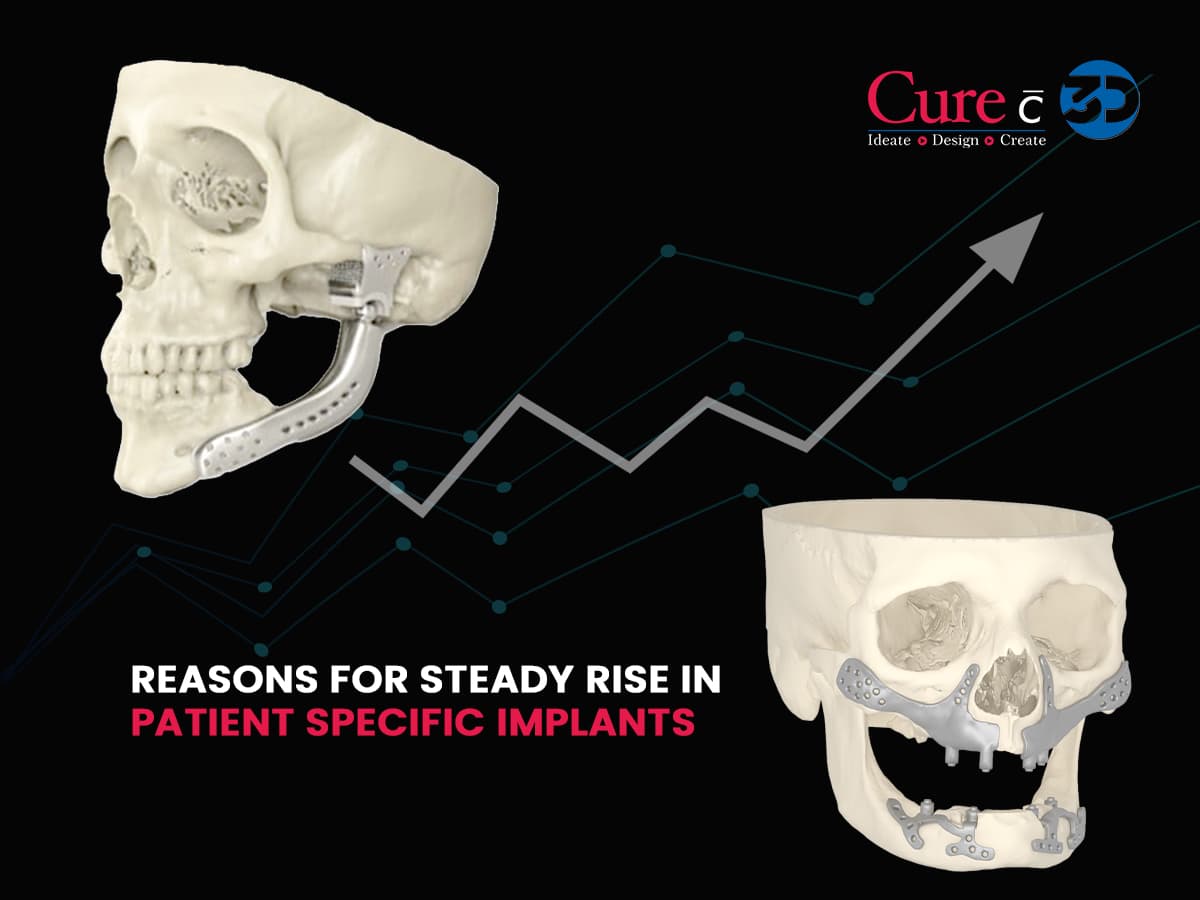
Reasons for Steady Rise in Patient Specific Orthopedic Implants
Ever imagined your orthopedic implant being tailor-made just for you?
In a world where joint replacements are skyrocketing, custom-fit solutions are catching fire. By 2030 the U.S. alone may perform around 1.28 million knee and 635,000 hip replacements each year. These surgeries often depend on orthopaedic implants to restore mobility and quality of life. Yet traditional implants are “one-size-fits-most,” not perfect for each patient. This mismatch can lengthen surgery, slow healing, and even cause revisions. No wonder surgeons and hospitals are turning to patient-specific 3D-printed implants – devices engineered from a patient’s own anatomy.
According to recent analyses, patient-specific implants are gaining ground rapidly. These custom devices are designed from CT/MRI scans, then 3D-printed in biocompatible materials (titanium, PEEK, etc.) to match each bone’s shape. Curewith3D, for example, emphasizes that with custom implants “every curve, angle, and contour is crafted based on high-resolution CT/MRI data,” yielding an implant that “feels as natural as the body it supports” In plain terms, it’s like getting a suit tailored instead of grabbing one off the rack – the fit (and results) can be far superior.
The Dilemma: When “Standard” Falls Short
Orthopedic surgeries are among the most common procedures in hospitals. Many require implants: hips, knees, plates for fractures, spine hardware, and more. But standard implants come pre-designed for an “average” patient. In the OR, surgeons often must bend or cut these implants to fit the actual patient’s bone – a process that adds time, imprecision, and fatigue.
- Poor fit and extra surgery time: Off-the-shelf orthopaedic plates and screws rarely match unique bone shapes. Surgeons end up bending plates or reaming bone during surgery, which can lengthen anesthesia time. The goal of patient-specific implants is exactly to reduce surgical time and improve outcomes
- Suboptimal outcomes: A generic implant may not sit flush against the bone, risking micro-movements or stress. This can lead to slower healing or even implant loosening. Ultimately, patients might suffer pain or need a second operation.
- Growing demand: With aging populations and more injuries (sports, accidents), joint replacements are soaring. For example, even conservative forecasts predict nearly 1.3 million knee replacements per year by 2030. Traditional implants strain to keep up.
In short, “one-size-fits-none” is a real problem in orthopedics. The demand for implants is “rapidly increasing,” and hospitals want solutions that make surgeries quicker and safer. Custom implants tackle these issues head-on by fitting each patient exactly.
Custom-Fit Implants: A Perfect Anatomical Match
Patient-specific implants are engineered from the ground up for one person’s anatomy. Using the patient’s own CT or MRI scans, designers create a 3D digital model of the bone and plan the implant to fit it precisely. As Curewith3D puts it, these implants are “engineered to fit your patient’s exact anatomy, without any compromise”
How does this help? Imagine a puzzle piece that fits exactly, instead of forcing a mismatched piece. Custom implants eliminate gaps between implant and bone, giving surgeons “improved alignment, better intraoperative clarity, and a smoother surgical process.” In trauma cases, this means pre-shaped plates that hug the bone contours perfectly, rather than flat plates that must be bent in surgery. In joint replacements, it means cutting bone to accommodate the implant geometry the way we want, not the other way around.
Key benefits of patient-specific implants include:
- Perfect anatomical fit: The implant matches the patient’s unique bone shape This precision can improve joint alignment and function.
- Shorter surgery times: Because the implant is pre-planned and often comes with custom guides, surgeons save time. Curewith3D notes that this leads to “millimeter-perfect accuracy during complex procedures” and a smoother workflow
- Fewer complications: A tighter fit and preoperative planning reduce the chance of intraoperative surprises (like needing extra bone cuts), which lowers infection or bleeding risks. As Curewith3D highlights, custom implants can lead to “fewer complications” and “faster healing” compared to traditional parts
- Faster recovery: When an implant fits like a glove, bone grows into it more quickly and pain is often reduced. The result is typically a speedier return to mobility.
A quick comparison:
| Feature | Standard Implant | Patient-Specific Implant (PSI) |
| Fit to Bone | Generic, may require bending/shaping | Exact anatomical fit (modeled from patient’s scans) |
| Surgical Prep | Standard off-the-shelf inventory | Custom 3D design & planning before surgery |
| Surgery Time | Potentially longer (adjustments needed) | Typically shorter (pre-planned placement) |
| Complication Risk | Higher risk of mismatch or implant loosening | Lower risk due to precise design |
| Materials Used | Common medical metals/plastics | Same biocompatible materials (Ti, PEEK) but optimized design |
Printing the Future: How 3D Tech Makes It Possible
3D printing (additive manufacturing) is the engine behind custom implants. Instead of machining metal blocks, printers build the implant layer by layer from a digital model This approach allows complex shapes that would be impossible or too costly with traditional methods. For instance, a custom hip implant might have an internal porous structure to help bone grow in, something easily done with 3D printing.
According to experts, 3D printing in orthopedics is especially exciting because it can be done on demand, on-site A patient’s scan data is turned into a CAD model of the implant, then sent to a printer. The printer (often using titanium powder and lasers) builds the piece precisely. The end result is a biocompatible, medical-grade implant made just for that person. No need for central factories or long waits – hospitals and implant manufacturers are increasingly setting up local 3D printing labs for quick turnaround.
This high-tech process is not science fiction. It’s reality: surgeons now routinely use 3D-printed guides and models for pre-surgical planning, and the leap to actual implants has been accelerating. In fact, 3D-printed patient-specific implants and guides are praised as a “new technology for increased precision and productivity in treating complex musculoskeletal pathologies” In short, 3D printing turns a digital plan into a perfect, personalized piece of hardware.
Benefits for Surgeons and Patients
Surgeons and patients both benefit when an implant is made to fit. Here are some direct gains that drive the trend:
- Better surgical accuracy: With a custom implant and often matching cutting guides, surgeons can place hardware with sub-millimeter precision. Curewith3D notes that this leads to “improved alignment” and greater confidence during surgery
- Reduced operative time: Custom planning means less guesswork mid-surgery. By some estimates, pre-planned patient-specific solutions can cut down surgery time significantly – saving hours in the OR and freeing the team for other cases.
- Higher success rates: Case reports show that tumors or deformities can be tackled more aggressively when the replacement implant is pre-shaped. For example, bone tumor surgeries using custom titanium prostheses have reported excellent functional scores (around 80% on the MSTS scale) and high implant stability In simpler terms, patients often end up walking better, with fewer setbacks.
- Faster healing and rehab: Since custom implants fit so well, patients usually experience less post-op pain and can start rehab sooner. Curewith3D highlights “faster healing” as a key benefit A well-fitting implant also means bone grafts or allografts (if used) integrate more smoothly.
Surgeons themselves note the difference. Dr. Aidan McAnena and colleagues summarize that patient-specific implants allow surgeons to preserve anatomy and function even after big resections (like tumor removal) The custom piece acts almost like a piece of the patient’s own bone, rather than a generic patch. This not only helps the patient recover, but it gives the surgical team a sense of control – reducing intraoperative surprises.
Overall, custom implants are a problem-solving tool in the OR: they solve fit issues, decrease intraoperative modifications, and help manage complex cases with confidence.
Market Growth and Demand
The shift toward custom implants isn’t just buzz – the market stats are skyrocketing. Analysts project tremendous growth for the 3D-printed medical implant sector:
| Market Segment | Now (2022/25) | Future (2030/34) | CAGR |
| 3D-Printed Medical Implants (Global) | $2.66B (2025) | $9.81B (2034) | ~15.9% |
| Orthopedic 3D Printing Devices | $2.75B (2025) | $6.87B (2034) | ~11.2% |
| Personalized 3D Orthopedic Implants | $915.7M (2022) | $1.78B (2030) | ~17.0% |
Table: Projected growth of the 3D-printed implant market
These numbers aren’t just fancy projections – they reflect a real clinical demand. Hospitals and surgeons recognize that patient-specific implants can improve outcomes and efficiency, driving investment. Other factors fueling growth include: an aging population needing more joint replacements, rising obesity and sports injuries (which increase trauma cases), and continuous R&D.
Put simply, the high demand for better, faster healing is pushing healthcare providers to adopt these new solutions. In North America alone, nearly 36% of the global 3D-printed implant market resides, showing that U.S. hospitals are leading the charge. As more data comes in, even more hospitals worldwide are ordering custom implants, convinced by their benefits.
Custom 3D Printed Implants Across Medicine
Patient-specific implants aren’t limited to knees and hips. The technology spans multiple specialties:
- Orthopedics: Beyond joint replacements, custom orthopaedic plates are used for complex fractures and bone deformities. Curewith3D offers “patient-specific 3D trauma implants” and anatomically contoured plates that match a patient’s broken bone geometry. For spine surgery, custom vertebral body implants can rebuild vertebrae precisely after tumor removal.
- Craniofacial and Neurosurgery: Custom cranial plates (for skull reconstruction) and maxillofacial implants (for jaw and face) are already common. Tailored plates can restore normal skull or face contours after injury, often with better cosmetic and functional outcomes.
- Dental and Oral Surgery: Custom dental implants and jaw reconstruction guides improve accuracy in reconstructing the mouth. For example, a patient needing a full-jaw implant can get a personalized titanium scaffold that matches the jaw arc exactly. Curewith3D explicitly markets patient-specific dental and chin implants for surgical precision
- Oncology & Reconstruction: Patients undergoing tumor resection in bone (pelvis, limbs) can receive a one-off custom prosthesis that replaces exactly the bone that was removed. Studies have shown that using these 3D-printed tumor implants can preserve limb function even after large tumor cuts
In essence, if it’s a medical implant, chances are a custom 3D-printed version exists or is in development. Designers use the same workflow of imaging, then CAD modeling, 3D printing for any body part that needs a perfect-fit implant. This versatility means patient-specific implants are solving problems for trauma surgeons, oncologists, dentists, and more, not just orthopaedists.
Why Surgeons Are Getting Onboard with 3D Printed Medical Implants?
Surgeons are practical; they adopt new tools if those tools solve real problems. Here’s what clinicians say about patient-specific implants:
- Many report smoother surgeries. Having a pre-designed implant (and even custom cutting guides) means the pre-op planning is thorough. One doctor quipped that using a custom guide is like “having GPS for surgery” – it tells you exactly how much bone to remove and where. This precision reduces guesswork.
- Success stories: Case reports frequently note excellent outcomes. For instance, patients with irregular bone defects (from tumors or previous failed surgeries) have recovered with full function using custom implants. One study found 80-85% functional scores in patients who got a 3D-printed custom bone replacement. That’s on par with standard implants in simpler cases.
- Patient satisfaction: Many surgeons note happier patients post-op. When pain is lower and mobility better because the fit was exact, word-of-mouth (and feedback surveys) show higher satisfaction. Less leg-length discrepancy, for example, is reported when hip implants are custom.
To meet this demand, companies like Curewith3D partner with surgical teams to design cases. Their platform “elevates your workflow,” in their words, by taking a CT scan and turning it into a surgeon-ready implant plan. Clinics use such services to augment their capabilities, especially for rare or difficult cases. As 3D printing becomes more mainstream in hospitals, more surgeons view patient-specific implants as part of the standard toolkit – not a niche option.
Overcoming Hurdles: The Road Ahead
Despite the enthusiasm, some hurdles remain in the widespread switch to custom implants:
- Cost and logistics: Custom implants can be more expensive initially than mass-produced ones. Designing and printing a unique implant is resource-intensive. However, many argue that these costs are offset by savings from shorter surgery times, fewer complications, and faster rehab. As 3D printing scales up, prices are slowly dropping.
- Regulation and standardization: Since each implant is unique, regulatory bodies like the FDA are still adapting. Manufacturers must demonstrate safety and quality for each design. There’s a push in the industry to standardize workflows (e.g. certified materials, validated software) so that custom implants can be approved more smoothly.
- Surgeon training: Using custom implants requires new skills in digital planning and collaboration with engineers. Many hospitals now train surgical teams on virtual surgical planning. Fortunately, the technology is becoming more user-friendly (and sometimes semi-automated by AI), lowering the learning curve.
Research and real-world use are addressing these challenges. For example, improved printing materials now mimic natural bone porosity, aiding integration. Investment continues: one report notes major funding in 2024 for 3D printed orthopaedic ventures. The future looks promising as companies refine the process.
Custom Implants in Action
At its heart, the rise of patient-specific implants is all about solving problems:
- Problem: Patients’ bones and injuries are unique, but standard implants are generic.
- Solution: Use medical imaging to capture patient anatomy, then 3D print a one-of-a-kind custom implant.
- Problem: Surgeons spend extra OR time adapting devices.
- Solution: Pre-plan with custom guides and implants to cut time and guesswork.
- Problem: Standard implants can fail in very complex cases (tumors, severe deformities).
- Solution: Custom titanium replacements allow surgeons to remove diseased bone aggressively without sacrificing function.
These examples show a clear cause-and-effect: each challenge of “one-size” is addressed by a tailored approach. As one industry summary notes, the goal is to “maximize patient outcomes” and “minimize surgical time,” exactly what custom implants are built to do.
The Future is Personalized (and Printed)
In the next decade, expect to see custom implants become routine for many surgeries. The technology is still young, but momentum is building fast. By aligning digital health (imaging), advanced manufacturing (3D printing), and surgical expertise, patient-specific implants promise a precision medicine approach to orthopedics. Surgeons and hospitals that embrace this are already seeing the difference in their OR efficiency and patient recoveries.
The shift from standard to patient-specific implants is driven by clear benefits: better fit, faster surgeries, and happier patients. In a nutshell, custom 3D-printed implants are solving problems that off-the-shelf conventional implants can’t – and that’s why their use is steadily rising among orthopedic professionals and beyond.
References:
- McAnena AP, McClennen T, Zheng H. Patient-Specific 3-Dimensional-Printed Orthopedic Implants and Surgical Devices Are Potential Alternatives to Conventional Technology But Require Additional Characterization. Clin Orthop Surg. 2025 Feb;17(1):1-15. doi: 10.4055/cios23294. Epub 2024 Jun 26. PMID: 39912074; PMCID: PMC11791502.