
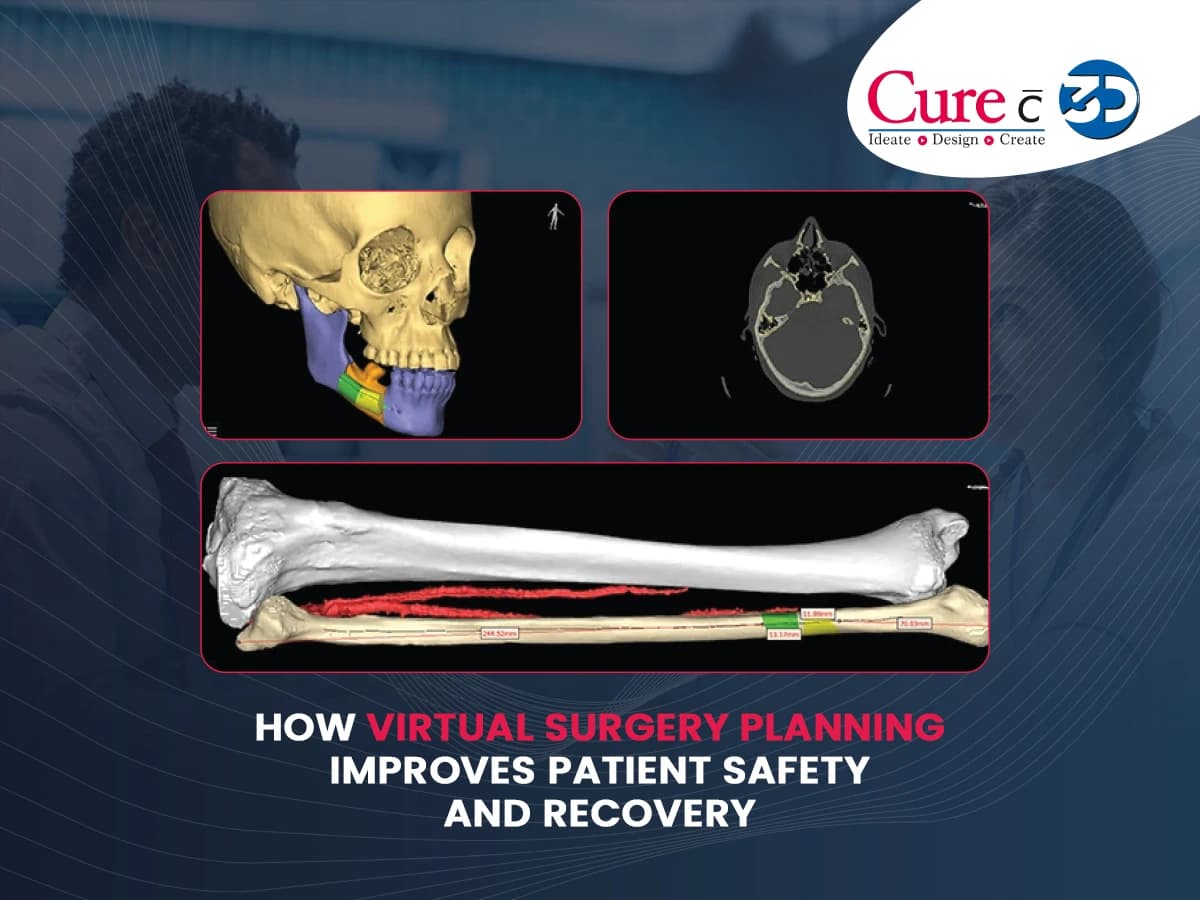
How Virtual Surgery Planning Improves Patient Safety and Recovery
With the advent of time and more investment in healthcare, technological advancements in modern surgery are gaining more fame. Modern technological advancements result in enhanced patient safety, surgical accuracy, and better recovery outcomes. One of the major advancements is virtual surgery planning (VSP), a precision-based surgical planning solution.
VSP represents a significant breakthrough in orthognathic and oral and maxillofacial surgery. This powerful innovation reflects the continuous progress within these specialties. Emerging from the digital transformation in healthcare, VSP integrates computer-based technologies, sophisticated imaging systems, and simulation software to accurately design and prepare for complex surgical procedures.
Curewith3D, a leading platform in advanced 3D surgical solutions, is proficient in VSP. With Curewith3D, you can visualise and plan every intricate detail of your surgery. For better clarity in complex cases, Curewith3D can be the perfect surgical planning solution for you.
What is Virtual Surgery Planning?
Virtual surgery planning (VSP) is a digital process that allows surgeons to simulate procedures in a 3D environment before entering the operating room.
Using CT or CBCT scan data, specialized software converts patient anatomy into highly accurate 3D models. Surgeons can then:
- Analyze bone structures and anatomical landmarks
- Simulate surgical movements
- Predict post-operative outcomes
- Design custom surgical guides and splints
Rather than making critical decisions during surgery, everything is planned, measured, and optimised in advance. This proactive approach reduces uncertainty and enhances surgical control, two key factors in improving patient safety.
How Does Virtual Surgery Planning (VSP) Work?
There are 4 major steps required in VSP:
- CT/CBCT scan data collection: A surgeon will first take all the required visual data through 3D images and CT scans. Sometimes they may use an MRI.
- 3D anatomical reconstruction: Next, the surgeon will use these images to separate and isolate key components of your anatomy for a more detailed analysis. Once the surgeon has created these segments, they will then integrate other images, such as 3D scans, to help provide other information, like texture and nerves.
- Surgical simulation and digital mock surgery: Now, the surgeon will perform the actual VSP, where the surgeon takes all the previous data to create a surgery plan.
- Creation of surgical guides and splints: Finally, the surgeon may choose to manufacture or print the 3D VSP model.
Why Virtual Surgery Planning Matters in Orthognathic Procedures?
Orthognathic surgery corrects jaw misalignment, bite discrepancies, facial asymmetry, and functional issues such as difficulty chewing or breathing. Because these procedures involve repositioning the upper jaw, lower jaw, or both, precision is critical.
Traditional Orthognathic Surgery Planning vs. Digital Planning
Historically, orthognathic surgery planning relied on:
- Physical dental impressions
- Plaster models
- Manual measurements
- 2D radiographs
- Hand-fabricated surgical splints
While effective for decades, these methods have limitations:
- Potential human error
- Limited visualisation of 3D structures
- Time-consuming lab processes
- Less predictability in complex cases
In contrast, 3D orthognathic surgery planning allows for comprehensive digital simulation. Surgeons can rotate, measure, and reposition jaws virtually, viewing outcomes from every angle before surgery even begins.
This shift from manual to digital planning significantly improves accuracy and patient outcomes.
How Virtual Surgery Planning Improves Patient Safety
Patient safety is the top priority in any surgical procedure. Virtual surgery planning enhances safety in multiple measurable ways.
1. Reduced Risk of Surgical Complications
By mapping the patient’s anatomy in 3D, surgeons can identify critical nerves and blood vessels, evaluate bone thickness and density, avoid anatomical obstacles, and plan precise osteotomy lines.
This level of preparation reduces the likelihood of accidental damage and unexpected intraoperative complications. Instead of reacting to challenges in the operating room, surgeons proactively address them during the digital planning stage.
2. Shorter Operating Time
Operating time is directly linked to patient safety. The longer a procedure lasts, the greater the exposure to anaesthesia-related risks and infection.
With virtual surgery planning, many intraoperative decisions are already finalised, including pre-designed surgical guides, predetermined jaw repositioning measurements, and custom-fabricated splints using digital data. This streamlined workflow reduces guesswork and shortens procedure time, contributing to safer surgical experiences.
3. Increased Surgical Accuracy
In jaw correction procedures, even a 1-2 mm deviation can affect bite alignment, facial symmetry, and long-term stability. 3D orthognathic surgery planning enables millimeter-level precision by digitally measuring movements before surgery. Custom guides translate that digital accuracy into the operating room.
Greater precision leads to improved occlusion outcomes, enhanced facial balance, and reduced need for revision surgeries. Fewer revisions mean fewer risks and better patient trust.
4. Enhanced Multidisciplinary Collaboration
Orthognathic treatment often involves oral and maxillofacial surgeons, orthodontists, and lab technicians.
Digital planning platforms allow all specialists to review and collaborate on the same 3D model. This alignment ensures clear communication, shared treatment goals, and coordinated execution. When every provider works from the same precise data set, patient safety improves.
How Virtual Surgery Planning Enhances Recovery
Safety during surgery is critical, but recovery outcomes are equally important. Virtual surgery planning contributes to faster, smoother healing in several ways.
1. Less Tissue Trauma
Because surgical cuts and movements are precisely mapped, surgeons avoid unnecessary bone or soft tissue manipulation. Precise osteotomies mean reduced swelling, less postoperative pain, and lower inflammation. Minimised trauma supports the body’s natural healing process.
2. Improved Functional Outcomes
The primary goal of orthognathic surgery planning is to correct bite and jaw alignment. When jaw repositioning is digitally calculated, occlusion is more predictable, jaw function improves, chewing efficiency increases, speech clarity may improve, and airway space can be optimized
Better functional outcomes directly contribute to long-term patient satisfaction and reduced recovery complications.
3. Greater Aesthetic Predictability
Facial symmetry plays a major role in patient confidence. With 3D orthognathic surgery planning, surgeons can simulate jaw advancement or setback, chin repositioning, and facial balance changes. Patients can visualise potential outcomes before surgery, improving informed consent and reducing anxiety. When expectations align with results, recovery feels more reassuring and less stressful.
4. Reduced Need for Revisions
Accurate digital planning decreases the likelihood of bite instability, relapse, and asymmetry corrections
Avoiding secondary procedures significantly improves overall recovery timelines and patient experience.
Why Choose Curewith3D for Virtual Surgery Planning?
At Curewith3d, we specialise in advanced virtual surgery planning solutions tailored to complex maxillofacial and orthognathic procedures.
Advanced 3D Technology
Our 3D orthognathic surgery planning process integrates high-resolution imaging data, detailed anatomical modelling, precision surgical simulations, and custom-designed surgical guides. Every plan is developed with a focus on accuracy, safety, and clinical predictability.
Collaborative Expertise
We work closely with surgeons and orthodontists to review cases in detail, refine surgical movements, and ensure alignment between treatment phases. This partnership-driven approach ensures that each case receives personalised attention and meticulous planning.
Commitment to Precision and Patient Safety
At Curewith3D, patient safety is not an afterthought; it is the foundation of every digital plan. By combining advanced software with expert planning specialists, we help surgeons reduce intraoperative uncertainty, improve surgical efficiency, and deliver predictable, stable outcomes
When planning improves, performance improves, and patients benefit.
Conclusion
Modern surgery demands modern solutions. Virtual surgery planning transforms complex procedures from reactive interventions into carefully engineered processes. In orthognathic surgery planning, this digital approach delivers greater precision with reduced surgical risk. With advanced 3D orthognathic surgery planning, surgeons operate with clarity and confidence, and patients recover with greater comfort and peace of mind.At Curewith3D, we believe better planning leads to better healing. By integrating cutting-edge 3D technology with expert collaboration, we help elevate patient safety and redefine recovery standards in modern surgical care.