
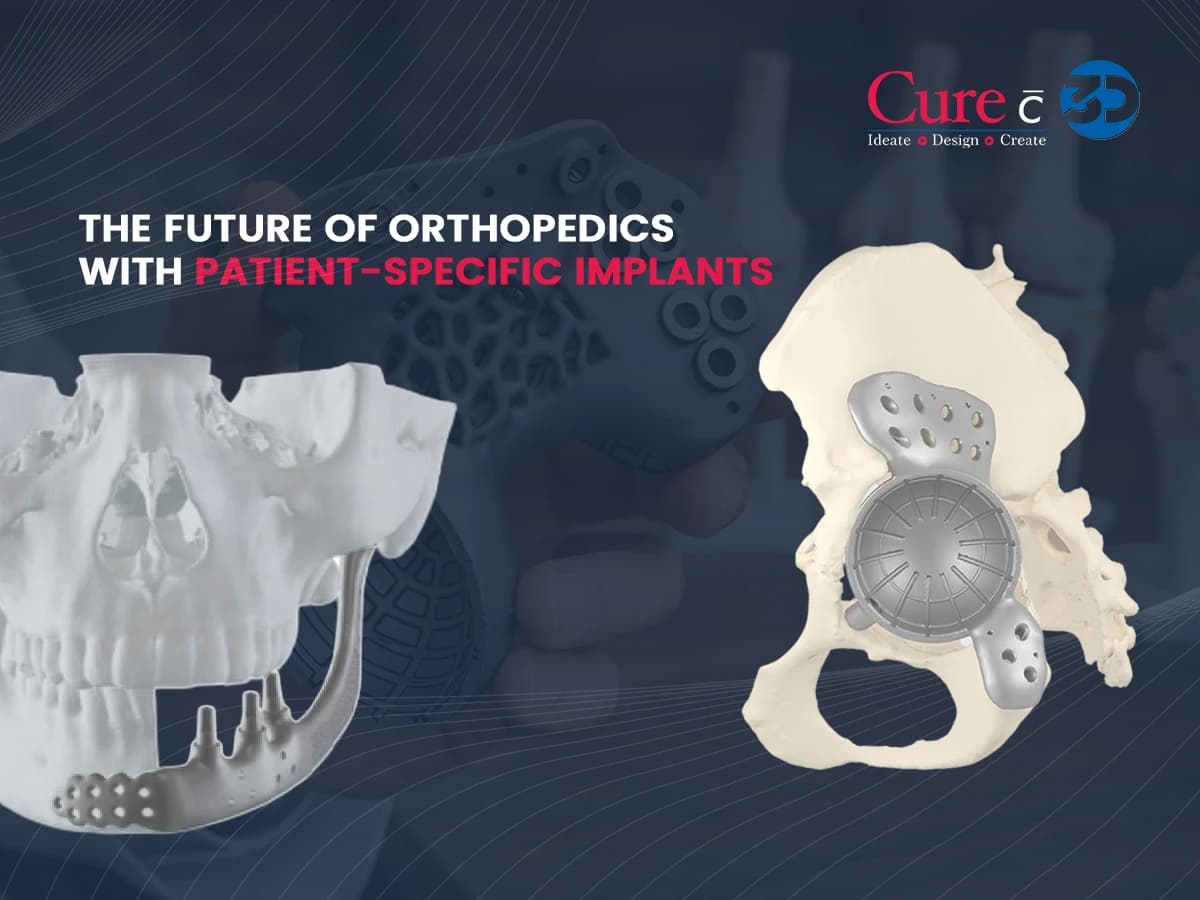
The Future of Orthopedics with Patient-Specific Implants
The frequency of orthopedic surgeries in India has dramatically increased over the past few years. In 2022, India performed approximately 5.68 million orthopedic procedures, including trauma fixation, arthroscopy, hip and knee replacements, and spinal surgeries. This growing surgical volume is driven by an aging population, increased incidence of osteoarthritis, sports-related injuries, and greater access to healthcare services. The rising demand for orthopedic procedures has also fueled innovation aimed at improving surgical outcomes and efficiency.
Many orthopedic surgeries require the replacement or repair of bone tissue; thus, the need for orthopedic implants is increasing rapidly. The Indian orthopedic implants market, valued at around USD 2.35 billion in 2024, is projected to grow to nearly USD 4.95 billion by 2033, reflecting an annual growth rate of ~8%. Implant technology is continuously improving, with a major shift towards patient-specific implants (PSIs). PSIs are engineered to fit an individual’s unique anatomy, constituting an effective treatment for various clinical conditions. The adoption of 3D-printed surgical guides, custom implants, and anatomical models is becoming increasingly common in India, enabling precise surgical planning, reduced operative time, and improved patient outcomes. Ultimately, the goal is to reduce overall procedure costs while maximizing safety, function, and longevity.
CureWith3D, a healthcare-innovation company, is at the forefront of this transformation. They create customized, patient-specific 3D-printed surgical guides, orthopedic and dental implants, and anatomical models that support advanced, personalized orthopedic care.
What are Patient-Specific Implants?
Patient-specific implants are also known as custom-made implants. These devices are designed for a specific patient’s anatomy. They can be created using materials like titanium, ceramics, and specialized polymers. Unlike traditional devices, these are produced using patient imaging data to perfectly match complex anatomical structures (e.g., craniofacial bones, joints). These implants are mainly used in maxillofacial surgery (reconstructing jaw/skull), orthopedics (hip/knee replacements), and dental implants.
Difference from Traditional Implants
- Fit and Customization: Traditional implants come in standard sizes, requiring surgeons to adjust them during surgery. PSIs are tailor-made for an exact anatomical match.
- Accuracy: PSIs reduce the need for manual, intraoperative adjustments (bending/cutting), improving surgical accuracy and reducing operating time.
- Bone Health: PSIs can include porous structures that promote bone ingrowth (osseointegration), enhancing stability.
- Cost: PSIs are generally more expensive than traditional implants due to advanced engineering and customization, though they may reduce overall hospital stay costs.
Customization Based on Patient Anatomy
PSIs are customized by analyzing specific patient needs before surgery:
- Anatomical Mirroring: For facial or cranial repairs, software can “mirror” the undamaged side to perfectly replicate the missing anatomy on the affected side.
- Bone Density Mapping: CAD models can match the mechanical properties of the surrounding bone, reducing stress shielding (where an implant is too stiff, causing surrounding bone to weaken).
- Surgical Guides: 3D printing also produces patient-specific guides that tell the surgeon exactly where to make cuts, ensuring the implant fits perfectly.
These implants are particularly vital when a patient’s bony geometry falls outside the range of standard implants.
Why Standard Implants Are No Longer Enough
Although standard orthopedic implants were foundational to fracture care for decades, they are increasingly recognized as insufficient for complex, patient-specific fracture patterns. Their “one-size-fits-most” design often fails to meet the anatomical, biomechanical, and biological demands of modern traumatology.
Limitations of Conventional Orthopedic Plates
Traditional orthopedic plates have many limitations, including the following:
- “One-Size-Fits-Most” Inaccuracy: Conventional plates are pre-contoured based on “average” anatomy. In complex fractures, this mismatch requires significant intraoperative bending, which can weaken the metal, compromise the locking mechanism, and lead to poor anatomic reduction.
- Biological Disruption (Periosteal Stripping): Traditional plates often require intimate contact with the bone to achieve stability through friction. This necessitates extensive dissection, damaging the surrounding soft tissue and stripping the periosteum, which is crucial for bone healing.
- Material and Design Failure: Constant rubbing of components, high stress, or fatigue can lead to implant loosening, wear, or breakage.
- Stress Shielding: Traditional metallic plates (stainless steel/titanium) are often much stiffer than bone. This results in the plate bearing the majority of the load, leaving the bone without the mechanical stimulation needed to heal properly, leading to weakened bone around the implant.
Challenges with Traditional Trauma Implants
Traditional trauma implants pose several challenges, leading to their lesser use.
- Osteoporotic Bone Limitations: In elderly patients, traditional screws struggle to gain purchase. This leads to higher rates of screw loosening and, ultimately, implant failure.
- Limited Customization: Standard implants cannot accommodate unique anatomical variations. This requires surgeons to compromise on positioning or spend excessive time adapting the hardware during surgery.
- Infection Risk: The extensive soft tissue dissection needed for standard plating increases the risk of infection, which can necessitate further surgery.
Fit and Alignment Issues in Complex Fractures
- Incongruous Anatomical Fit: In periarticular fractures (near joints like the knee or ankle), an imprecise fit leads to articular step-off or malalignment, which causes long-term chronic pain, reduced range of motion, and early-onset arthritis.
- Poor Fracture Reduction: Because traditional plates do not match the bone perfectly, tightening screws can shift the bone fragments away from the desired anatomical position (malreduction).
- Limited Fixation Sites: Complex, fragmented bones require specific, often irregular, screw trajectories that standard, straight plates cannot provide, resulting in unstable constructs.
Complications in Revision Surgeries
- High Complexity and Risk: Revision surgery, which is often needed when traditional implants fail, is far more difficult than the primary procedure. It often involves overcoming scar tissue, removing firmly integrated hardware, and dealing with significantly compromised bone stock.
- Further Bone Damage: The process of removing older, failed implants can cause further damage to weakened bone, necessitating complex, custom solutions or bone grafting.
- Infection and Nonunion: The high rate of complications, such as infection, nonunion (failure to heal), or premature screw loosening in initial surgeries, leads to a vicious cycle of repeated, risky, and expensive operations.
The industry is shifting toward 3D-printed Patient-Specific Implants and 3D-assisted surgical guides to overcome these limitations. PSIs provide a perfect anatomical fit, improving surgical efficiency, and reducing operating time and complications.
Why Choose Curewith3D for Patient-Specific Implants?
Curewith3D, a healthcare-innovation platform, creates customized, patient-specific implants. These 3D-printed PSIs have significantly better benefits over traditional implants, which are created in bulk.
- Enhanced Anatomical Fit: Curewith3D creates designs using patients’ CT/MRI data, resulting in a more accurate fit and reduced intraoperative adjustments.
- Improved Surgical Outcomes: The custom-created 3D implants result in better alignment and load distribution. Using a PSI reduces surgery time significantly
- Faster Recovery: The PSIs created by Curewith3D result in improved stability compared to generic orthopedic plates. Non-customised implants have a higher risk of implant-related complications, including implant loosening, breakage, or migration.
- Better Outcomes in Joint Replacement: The adaptation of customized PSIs has resulted in improved mobility and increased implant longevity. Personalized hip replacement implants from Curewith3D have thus become a novel innovation in healthcare.
3D-created PSIs from Curewith3d, thus, result in better surgical outcomes, improved efficiency, and minute implant-related complications.
Applications of Patient-Specific Implants in Orthopedics
The high success rate of using patient-specific implants in orthopedic surgery has increased their use and demand actively.
The application of PSIs in orthopedics includes the following:
- Complex Trauma Cases: Custom-designed trauma implants for irregular fractures are reported to have a significantly higher success rate than traditional implants. PSIs are now being increasingly used in high-energy injuries and deformity corrections.
- Joint Reconstruction: In joint reconstruction, personalized hip replacement implants result in better surgical outcomes when compared with traditional implants. They are now also being actively used in knee and shoulder replacement surgeries.
- Revision Surgeries: Surgeries performed with traditional implants might require a revision surgery because of fit and alignment issues. PSIs address the anatomical changes beforehand, so there may not be a need for revision surgery afterwards.
Challenges and Considerations with the Use of PSIs
Although PSIs are one of the major breakthroughs in healthcare, they do come with some challenges that need to be considered before their use.
Some of the major challenges with the use of PSIs are:
- Cost Implications: PSIs are considerably more expensive than standard traditional implants. The high cost is driven by the need for specialized 3D imaging, computer-aided design (CAD) software, expert engineer labor, and advanced 3D printing technologies.
- Production Time: The turnaround time for designing and manufacturing customized implants can be substantial, often requiring several days or even weeks. This delay can be problematic for urgent cases, such as in trauma or cancer resection, where rapid intervention is required.
- Regulatory Approvals: The regulatory landscape for PSIs is complex and can be restrictive. Because each implant is unique, it requires individual assessment rather than standard batch approval. While many custom devices fall under “custom-made” exemptions, navigating these legal pathways is challenging.
- Surgeon Training Requirements: Successful implementation of PSIs requires specialized knowledge of 3D software, anatomical interpretation, and collaborative skills to work effectively with biomedical engineers. The learning curve is steep, and there is a need for specialized, multidisciplinary training.
Conclusion
The transition from “one-size-fits-all” to “only one-size-fits-you” in orthopedics is no longer a futuristic concept but a present-day reality, driven by 3D printing and advanced imaging. PSIs have revolutionized reconstructive care, particularly for complex, non-standard cases where traditional implants fail. While challenges such as high upfront costs and long fabrication times currently exist, continued improvements in CAD/CAM technology are rapidly reducing these barriers.
The future of orthopedics is a personalized, digitally driven, and patient-centric experience. By exploring custom implant solutions from Curewith3D, healthcare providers can deliver superior care and “forget” the limitations of traditional, non-customized care.