
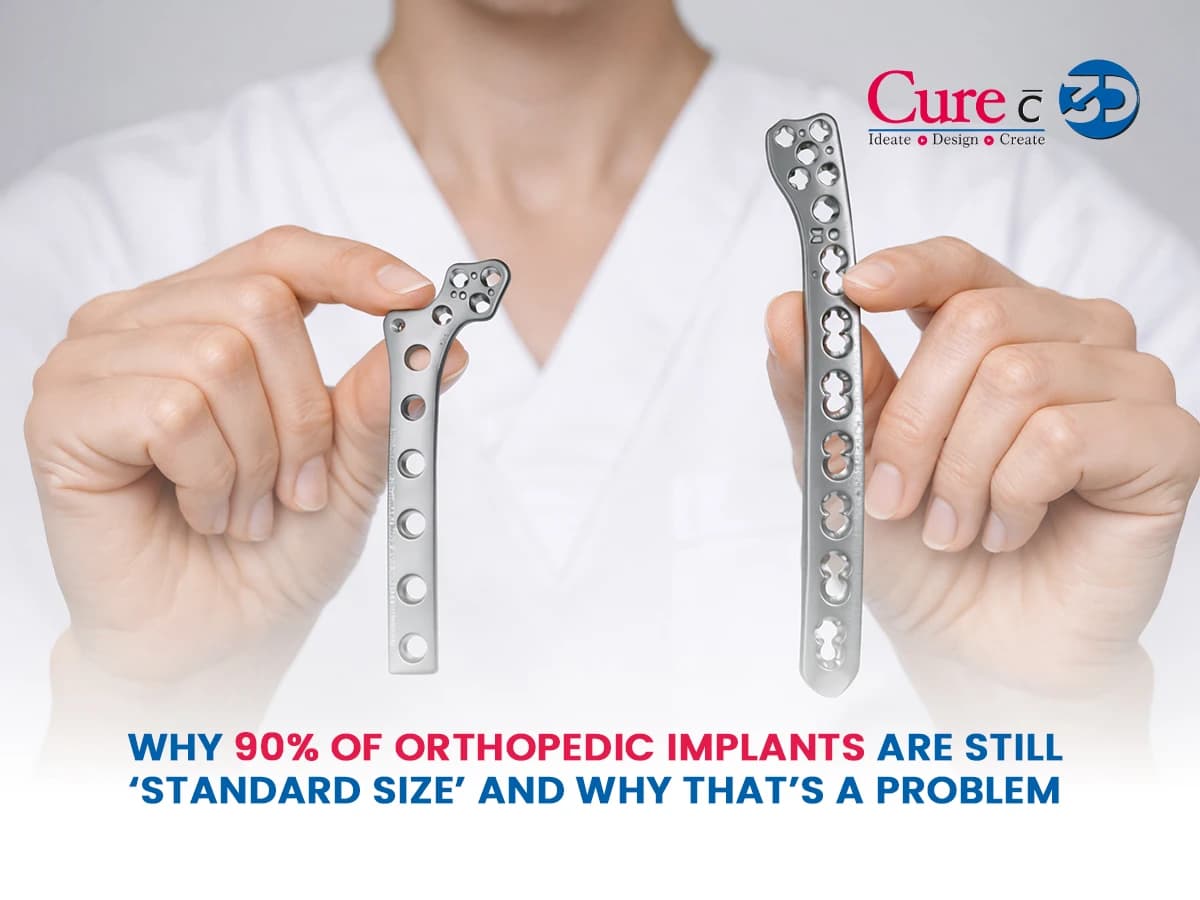
Why 90% of Orthopedic Implants Are Still ‘Standard Size’ and Why That’s a Problem
Healthcare is rapidly becoming personalized. Oncology uses genomic profiling. Cardiology relies on patient-specific imaging and intervention planning. Even pharmaceuticals are moving toward precision dosing. If medicine is personalized, then why aren’t most orthopedic implants? In orthopedics, nearly 90% of orthopedic implants are still manufactured in standardized size ranges. That mismatch between individual anatomy and mass-produced hardware is one of the most overlooked inefficiencies in modern surgery.
At Curewith3D, we believe the next evolution of orthopedics will not be incremental. It will be anatomical. It will be digital. And it will be patient-specific. This is why the dominance of standard-sized implants is a problem and why the shift toward patient-specific implants (PSIs) powered by 3D printing is inevitable.
The Legacy of Standardization in Orthopedic Implants
Orthopedic implants were built in the era of industrial scalability. Major manufacturers developed systems designed for global distribution, predictable regulatory pathways, and efficient operating room workflows.
The model made sense as it:
- produced implants in small, medium, and large size increments.
- supplied hospitals with trays covering multiple size options.
- allowed surgeons to select the “best fit” intraoperatively.
For decades, this approach scaled access to joint replacements and trauma care worldwide. It lowered the cost per unit and streamlined procurement. But it was never designed around anatomical individuality. It was designed around averages.
The Anatomical Reality: Humans Are Not Standard
No two femurs are identical. No two tibial plateaus are perfectly symmetrical. Bone curvature, canal geometry, cortical thickness, and joint morphology vary dramatically across gender, ethnicity, age, body composition, and pathology & deformity. Even within the same patient, the left and right sides can differ significantly. Standard implant systems attempt to approximate this variability through incremental sizing. But approximation is not precision.
When an implant does not perfectly match the patient’s anatomy, consequences can include:
- Implant overhang or under-coverage
- Soft tissue irritation
- Altered load distribution
- Suboptimal joint kinematics
- Accelerated wear
- Increased risk of revision
Many procedures are deemed “clinically successful,” yet patients report persistent discomfort or a limited range of motion. Often, the issue is not surgical skill; it is a geometric mismatch.
The Hidden Cost of “Good Enough”
Standardization appears cost-effective at first glance. Mass manufacturing reduces the unit price as hospitals stock predictable inventory and surgeons rely on familiar systems.
But the broader economics tells a more complex story.
- Inventory Burden: Hospitals must maintain large inventories to cover different size ranges. While many implants expire unused, storage, sterilization, and logistics also add operational overhead.
- Operating Room Inefficiency: Multiple trial components are opened to find the closest match, which increases surgical time and accumulates OR costs.
- Revision Surgeries: Even marginal misalignment or poor fit can contribute to early failure. Revision procedures are more complex, more expensive, and more taxing on patients.
- Patient Satisfaction and Reputation: In a value-based healthcare environment, patient-reported outcomes matter as functional dissatisfaction carries reputational and financial implications.
The older system works, but it is not optimized for precision, appropriate outcomes, or long-term value.
Where Standard Implants Fall Short
Standard-sized orthopedic implants are particularly limited in:
- Complex Deformities: Patients with congenital abnormalities or post-traumatic deformities rarely fit into standardized geometry.
- Oncology Reconstructions: Bone resections create irregular defects that require highly individualized reconstruction strategies.
- Severe Bone Loss and Revisions: Revision surgeries often involve compromised anatomy that off-the-shelf implants cannot adequately address.
- Patients Outside the “Average” Range: Very small or very large anatomical dimensions often require compromise when limited to predefined sizes.
These are precisely the scenarios where precision matters most, and where PSIs demonstrate clear value.
The Turning Point: Patient Specific Implants
The alternative is not incremental resizing. It is customization.
PSIs are designed from the individual’s own CT or MRI data. Instead of selecting the closest available implant, surgeons implant a device engineered for that patient’s exact anatomy.
The workflow is digital and consists of:
- High-resolution imaging
- 3D anatomical reconstruction
- Surgical planning
- Custom implant design
- Precision manufacturing
This transforms orthopedics from a size-selection process into an engineering process. And the difference is profound.
Rather than asking, “Which implant fits best?” We ask, “How should the implant be designed for this patient?”
Why 3D Printing Medical Implants Changes the Equation
Historically, customization was impractical. Traditional manufacturing methods like casting, forging, and CNC machining require economies of scale. Producing a single unique implant was expensive and slow.
But that barrier no longer exists.
3D printing medical implants, also known as additive manufacturing, enables:
- complex geometries impossible with subtractive methods.
- porous lattice structures for enhanced osseointegration.
- patient-matched curvature and contours.
- rapid iteration and low-volume production.
Instead of cutting material away from a block, additive manufacturing builds the implant layer by layer. Complexity no longer drives cost in the same way, and customization becomes scalable. Additive manufacturing also enables integrated porous surfaces that promote biological fixation, a critical advantage in complex reconstructions and revision cases.
The technology does not merely replicate traditional implants. It enhances them.
The Curewith3D Approach: Precision as Standard
At Curewith3D, we believe personalization should not be an exception reserved for extreme cases. It should be the foundation of modern orthopedics.
Our approach integrates:
- Digital-First Planning – Every case begins with detailed anatomical modeling. Surgeons collaborate with engineering teams to refine implant geometry before entering the operating room.
- Engineering-Driven Design – Implants are optimized for biomechanics, load transfer, and anatomical conformity, not constrained by pre-existing size molds.
- Advanced Additive Manufacturing – Using 3D printing, medical implant technologies, and medical-grade materials, we produce precision devices tailored to individual anatomy.
- Streamlined Workflow – Efficient digital pipelines reduce turnaround times while maintaining regulatory and quality rigor.
This is not customization for the sake of novelty. It is customization to reduce compromise.
Addressing the Barriers in the Adoption of PSIs
The transition from standardized to patient-specific systems raises valid questions.
Cost Per Implant
Custom implants may carry higher upfront pricing. But when considering reduced OR time, lower revision risk, decreased inventory burden, and improved patient outcomes, the value equation shifts.
Regulatory Considerations
Regulatory frameworks are evolving to accommodate personalized devices. With proper documentation, traceability, and validated workflows, patient-specific manufacturing is increasingly viable at scale.
Cultural Momentum
Orthopedics has decades of momentum behind standardized systems. Changing habits requires education, data, and trust.
But healthcare history shows a clear pattern: when outcomes improve, adoption follows.
The Future of Orthopedic Implants
We are entering an era where digital infrastructure defines clinical excellence.
In the coming decade, we anticipate:
- AI-assisted implant design
- Predictive biomechanical modeling
- On-demand manufacturing networks
- Hybrid systems combining standardized components with patient-specific interfaces
- Outcome-driven reimbursement models that reward precision
As imaging, computational modeling, and additive manufacturing mature, the argument for standard sizing weakens.
The question will shift from “Why customize?” to “Why not?”
To Conclude
The phrase “one-size-fits-most” has always implied compromise. Standard-sized orthopedic implants were a solution to a manufacturing challenge, but PSIs are a solution to an anatomical challenge. The question is no longer whether 3D printing medical implants can enable patient-specific implants. It already does.
The real question is how quickly the industry is willing to move beyond manufacturing convenience and toward anatomical truth. At Curewith3D, we believe the future of orthopedic implants will be defined by precision, not by averages.
And that future has already begun!