
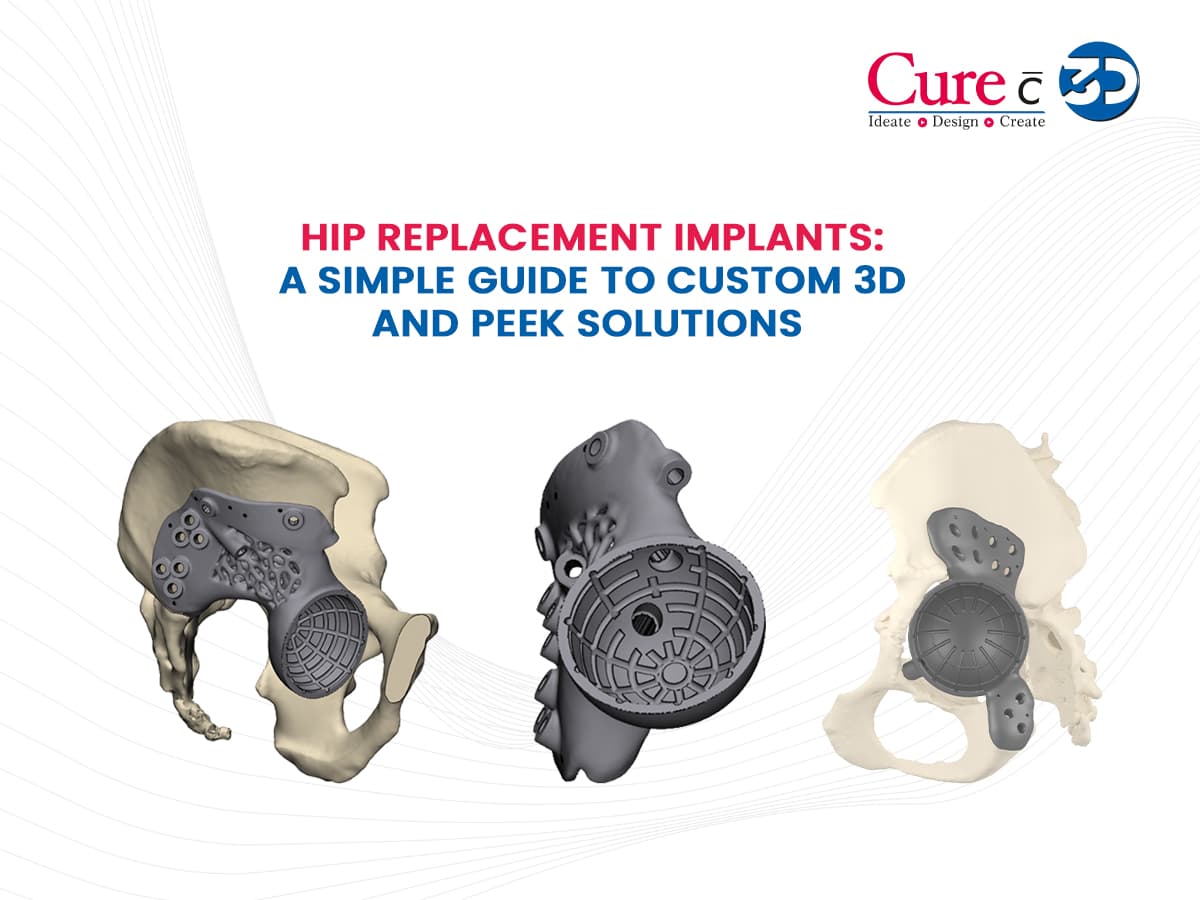
Hip Replacement Implants: A Simple Guide to Custom 3D and PEEK Solutions
A few years ago, 62-year-old Mr. Sharma began experiencing mild hip pain that he brushed off as part of aging. Over time, the discomfort grew worse. Morning walks stopped, stairs became a challenge, and even getting up from a chair required effort. Painkillers and physiotherapy provided only temporary relief. Eventually, his doctor recommended hip replacement surgery.
Like many patients, he worried about recovery, mobility, and long-term results. What reassured him was learning that modern hip replacement is no longer a one-size-fits-all solution. Today, surgeons focus on selecting the right implant for the right patient, based on individual anatomy, lifestyle, and bone health.
With advancements such as custom orthopedic implants, Custom 3D implants, and innovative materials like PEEK implants, hip replacement has become more precise and personalized than ever before.
What are Hip Replacement Implants?
Your hip joint works like a ball-and-socket joint. The ball is at the top of your thigh bone, and the socket is part of your pelvis. When this joint is damaged by arthritis, injury, or wear and tear, it can cause severe pain.
Hip replacement implants are artificial parts that replace the damaged ball-and-socket joint. These implants are designed to:
- Reduce pain
- Improve movement
- Restore normal walking
- Improve quality of life
Most traditional implants are made from metal, ceramic, and plastic. They are strong and have been used successfully for many years.
However, every person’s body is different. And that is where custom solutions are changing the future.
Why One-Size-Fits-All Does Not Always Work
Standard hip implants come in many sizes. Surgeons choose the closest fit during surgery. For many patients, this works well.
But what if:
- The patient has an unusual bone shape?
- Is there major bone loss?
- The patient had a previous failed surgery?
- Was the hip damaged due to a tumor or trauma?
In such cases, standard implants may not fit perfectly.
A poor fit can sometimes lead to:
- Uneven pressure on bones
- Loosening over time
- Longer surgery
- More bone removal than necessary
This is why custom orthopedic implants are becoming more popular.
What Are Custom Orthopedic Implants?
Custom orthopedic implants are designed specifically for one patient. They are not taken off a shelf. Instead, they are created after studying the patient’s CT or MRI scans.
The process usually works like this:
- The patient undergoes detailed scanning.
- Engineers create a 3D surgical model of the hip.
- Surgeons and designers plan the perfect implant shape.
- The implant is manufactured to match the patient’s anatomy exactly.
This approach ensures:
- Better fit
- Better balance
- More natural joint movement
- Less bone removal
For complex cases, this can make a big difference.
At Curewith3D, the focus is on creating solutions that match the patient, not forcing the patient to match the implant.
What are Custom 3D Implants?
Custom 3D implants are made using advanced 3D printing technology. Instead of carving an implant out of a metal block, 3D printing builds it layer by layer.
This method offers many benefits:
1. Exact Shape Matching
The implant mirrors the patient’s bone structure precisely.
2. Better Bone Attachment
3D printing allows the creation of tiny porous surfaces. These small pores help bone grow into the implant, making it more stable.
3. Faster Surgery
When the implant fits perfectly, surgeons spend less time adjusting sizes during the operation.
4. Lightweight Design
3D printing allows the creation of strong but lightweight structures.
Because of these advantages, Custom 3D implants are especially useful in:
- Revision hip surgeries
- Severe deformities
- Tumor reconstruction
- Major bone defects
Instead of adapting the surgery to a fixed implant, the implant is adapted to the surgery plan.
What is a PEEK Implant?
Now let’s talk about something newer and very interesting — the PEEK implant.
PEEK stands for Polyether Ether Ketone. It is a high-performance medical-grade polymer. That may sound technical, but here’s what matters in simple terms:
PEEK is:
- Strong
- Lightweight
- Biocompatible (safe inside the body)
- Similar in stiffness to natural bone
This last point is very important.
Why Does Implant Stiffness Matter?
Traditional hip replacement implants are usually made of metals such as titanium or cobalt-chrome. These metals are very strong; sometimes stronger than bone.
But if an implant is too stiff, it can take too much load away from the surrounding bone. Over time, the bone may weaken because it is not being used properly. This is called stress shielding.
PEEK has a stiffness closer to natural bone. This helps distribute weight more naturally. As a result:
- Bone may remain stronger
- The body may adapt better
- Long-term comfort may improve
Another advantage is that PEEK does not block X-rays. Doctors can clearly see healing bones on scans. This makes follow-up easier.
Titanium vs PEEK: Which Is Better?
There is no single best answer. Both materials have their place.
Titanium
- Very strong
- Long history of use
- Excellent for heavy load-bearing parts
PEEK
- Closer to bone stiffness
- Lightweight
- Radiolucent (clear on X-rays)
- May reduce stress shielding
In many cases, surgeons may combine materials to get the best of both worlds.
At Curewith3D, the goal is not to push a single material, but to choose the one that suits the patient best.
Who Benefits Most from Custom Hip Replacement Implants?
Custom solutions are especially helpful for:
- Patients with failed previous hip replacements
- Severe arthritis with bone deformity
- Hip damage after accidents
- Bone tumors
- Congenital hip problems
For a simple, first-time hip replacement with normal anatomy, a standard implant may work perfectly well.
But when things are complicated, personalization becomes powerful.
Are Custom Implants Safe?
Safety is always the first priority.
Custom implants go through:
- Design validation
- Mechanical testing
- Biocompatibility checks
- Sterilization protocols
- Regulatory approvals
When manufactured by experienced teams with proper standards, they are designed to be as safe and reliable as traditional implants.
Still, patients should always ask:
- Is the implant certified?
- What testing has been done?
- How many similar cases have been performed?
Transparency builds trust.
What About Cost?
Custom orthopedic implants are usually more expensive than standard ones. This is because:
- Detailed imaging is required
- Engineers spend time designing
- Manufacturing is patient-specific
However, in complex cases, they may reduce:
- Operation time
- Risk of revision
- Long hospital stays
In the long run, a better fit may mean better durability.
Every patient’s situation is different. The decision should balance cost, benefit, and long-term results.
The Future of Hip Replacement Implants
The world of hip replacement implants is evolving fast.
In the near future, we may see:
- Faster in-hospital 3D printing
- Bio-enhanced PEEK materials
- Even more natural joint movement designs
- Artificial intelligence is helping in implant planning
The focus is shifting from “fix the joint” to “restore natural biomechanics.”
And that is an exciting change.
Why Curewith3D Stands Out
Curewith3D believes that no two patients are identical. Bone shape, density, lifestyle, and medical history all matter.
By combining:
- Advanced imaging
- Precision engineering
- Custom 3D implants
- Innovative PEEK implant solutions
Curewith3D aims to provide implants that feel less artificial and more natural.
The goal is simple:
Better fit. Better function. Better life.
To Conclude
Hip replacement surgery is one of the most successful procedures in modern medicine. Millions of people walk pain-free because of it.
But medicine is always improving.
While traditional implants continue to serve many patients well, custom orthopedic implants, Custom 3D implants, and PEEK implant technology are opening new doors, especially for complex and challenging cases.
If you or a loved one is considering hip replacement, it is worth discussing personalized options with your surgeon. The right implant can make a real difference in recovery, comfort, and long-term success.
Every hip is unique. Your implant should be too.