
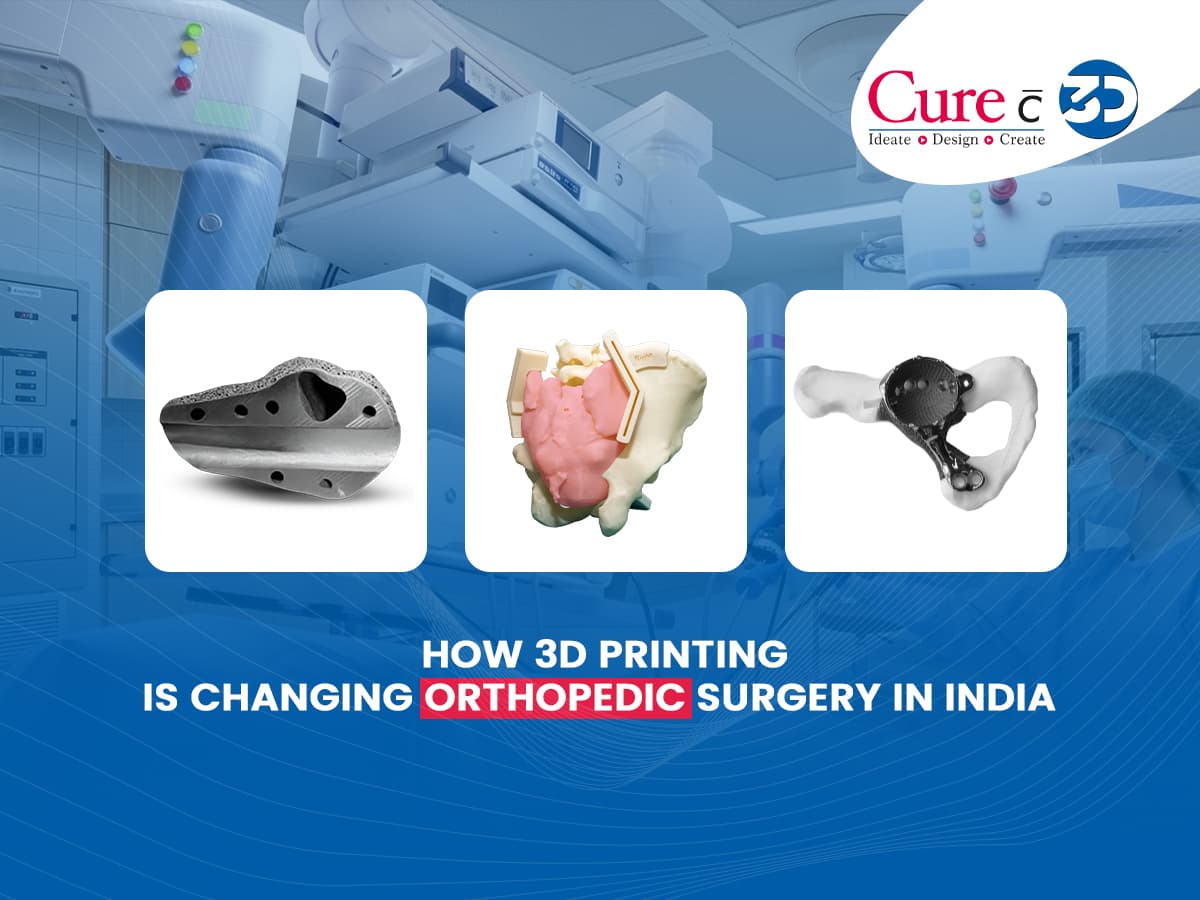
How 3D Printing is Changing Orthopedic Surgery in India
Healthcare in India is going through a quiet but powerful transformation. What once relied heavily on experience, 2D scans, and intraoperative decisions is now becoming far more precise, predictable, and personalized. At the center of this shift is one breakthrough innovation, 3D surgical models.
From complex fracture planning to custom implants, 3D printing anatomical models are redefining how orthopedic surgeries are planned and performed. Hospitals across India are actively adopting this technology.
But this is more than just a tech upgrade. It is a shift toward better outcomes, lower risks, and truly personalized care and companies like Curewith3D are playing a crucial role in making this accessible across India.
Understanding 3D Surgical Models in Simple Terms
Let’s break it down.
A 3D Surgical Model is a physical, real-life replica of a patient’s anatomy. It is created using data from CT scans or MRIs and then printed layer by layer using advanced 3D printing technology.
Instead of looking at flat images on a screen, surgeons can now hold the exact structure of a patient’s bone, joint, or organ in their hands.
This process is part of what we call 3D printing anatomy, converting medical imaging into tangible, highly accurate models.
These models can include:
- Bones with fractures or deformities
- Joint structures requiring replacement
- Tumor-affected areas
- Even cross-specialty examples like a human heart model 3D, used in cardiac planning
The result? Surgeons don’t just “imagine” the problem anymore; they see it, feel it, and plan it before entering the operating room.
Why Orthopedic Surgery Needs 3D Printing
Orthopedic cases are often complex. Every fracture is different. Every patient’s bone structure varies. And in many cases, millimeter-level accuracy determines success.
Traditionally, surgeons relied on:
- X-rays
- CT scans
- Their experience
While effective, these methods leave room for uncertainty.
This is where 3D surgical models change the game.
They allow surgeons to:
- Study the exact anatomy before surgery
- Plan cuts, angles, and implant positioning
- Reduce guesswork
In complex cases, like pelvic fractures, spinal deformities, or tumor resections, this level of preparation can significantly improve outcomes.
Real Impact: How 3D Printing is Used in Orthopedics
3D printing is of major advantage in orthopedic surgery. Here’s how:
Pre-Surgical Planning That Reduces Surprises
One of the biggest advantages of 3D printing anatomical models is pre-surgical planning. Surgeons can rehearse procedures on the model before performing the actual surgery.
This helps them:
- Identify potential challenges
- Decide the best surgical approach
- Reduce operation time
In many cases, surgeries that used to take 6-8 hours can be reduced significantly because the surgeon already knows exactly what to do.
Custom Implants Designed for the Patient
Every human body is different. Standard implants don’t always fit perfectly.
With 3D printing, implants can now be custom-designed for each patient. This leads to:
- Better fit
- Improved functionality
- Faster recovery
This is especially useful in:
- Joint replacements
- Bone reconstruction
- Tumor-related bone loss
- Precision Surgical Guides
3D printing also enables the creation of patient-specific surgical guides.
These guides help surgeons:
- Make accurate cuts
- Position implants correctly
- Maintain alignment
This reduces human error and improves surgical precision, something critical in orthopedic procedures.
Better Training and Patient Understanding
Another underrated benefit of 3D printing anatomy is education. Medical students and surgeons can train on realistic models instead of theoretical images. At the same time, patients can better understand their condition when doctors show them a physical model. This builds trust and improves decision-making.
Adoption Trends in India: Growing Faster Than Ever
India is quickly catching up with global leaders in medical 3D printing.
Leading institutes in India have been exploring 3D printing for research and surgical planning and have integrated 3D printing labs in collaboration with medtech innovators.
What’s driving this growth?
- Increasing complexity of surgeries
- Demand for better outcomes
- Rise of medical tourism
- Availability of local 3D printing solutions
Startups and specialized providers are now making 3D surgical models more accessible, not just in metro cities but gradually in Tier 2 and Tier 3 regions as well.
Benefits That Are Hard to Ignore
The adoption of 3D printing anatomical models is not just about innovation; it delivers real, measurable value. Surgeries become more predictable. When surgeons know exactly what they’re dealing with, the chances of complications reduce. Operation time also decreases. This not only reduces stress on the patient’s body but also lowers hospital costs. Recovery improves because implants fit better and procedures are more precise.
And perhaps most importantly, patients feel more confident. When they can see and understand their condition through a model, it removes fear and uncertainty.
The Challenges Slowing Down Growth
Despite its potential, 3D printing in India still faces hurdles.
Regulatory Complexity
India does not yet have fully standardized regulations for 3D-printed implants and models. Approvals can be complex, especially for patient-specific devices.
High Initial Investment
Setting up a 3D printing lab requires:
- Advanced printers
- Specialized software
- Skilled professionals
This can be expensive for smaller hospitals.
Skill Gap
3D printing sits at the intersection of medicine and engineering. There is still a shortage of professionals who understand both.
Import Dependency vs Local Manufacturing
Currently, India still relies heavily on imported:
- 3D printers
- Medical-grade materials
- Software solutions
This leads to higher costs and longer turnaround times.
Imported solutions are often:
- Expensive
- Less flexible for customization
- Slower due to logistics
But this is changing.
The Rise of Local Innovation
India is now seeing a shift toward local manufacturing.
Companies like Curewith3D are building India-focused solutions that are:
- Faster
- More cost-effective
- Designed for local healthcare needs
This reduces dependency on imports and makes 3D printing anatomy solutions more scalable across the country.
Make in India: A Massive Opportunity
Government initiatives like Make in India are creating the perfect environment for growth.
3D printing fits perfectly into this vision.
India has the potential to:
- Become a global hub for 3D printing anatomical models
- Export custom implants and surgical solutions
- Make advanced healthcare more affordable
With the right support, this sector can transform both healthcare and manufacturing.
What the Future Looks Like
The future of 3D surgical models in India is incredibly exciting.
We are moving toward:
- AI-assisted surgical planning
- Robotic surgeries combined with 3D models
- Bioprinting of bones and tissues
As technology evolves, surgeries will become even more precise, less invasive, and more personalized.
And importantly, these advancements will not remain limited to big cities. They will gradually reach smaller hospitals and towns.
Why Curewith3D is Leading This Transformation
In a rapidly evolving space, execution matters more than just technology. Curewith3D is positioned at the forefront because it understands both sides, clinical needs and technological precision.
The focus is simple:
- Deliver high-quality 3D surgical models
- Ensure fast turnaround times
- Keep solutions cost-effective for Indian hospitals
Unlike imported solutions, Curewith3D works closely with surgeons to create patient-specific implants that truly make a difference in the operating room. This is not just about innovation. It is about making advanced healthcare practical, scalable, and accessible.
Conclusion: A New Standard in Orthopedic Care
Orthopedic surgery in India is no longer limited to traditional methods.
With the rise of 3D printing anatomical models, surgeons are better prepared, patients are more informed, and outcomes are significantly improved. 3D surgical models are not the future anymore; they are the present. And as India moves toward self-reliance through initiatives like Make in India, companies like Curewith3D will play a key role in shaping the next generation of healthcare.
Because at the end of the day, this is not just about technology.
It is about giving every patient a better, safer, and more personalized chance at recovery.
FAQs
What exactly are 3D surgical models, and how are they used?
3D surgical models are physical replicas of a patient’s anatomy created using CT or MRI scans. Surgeons use them to better understand the condition, plan the surgery in advance, and perform procedures with higher accuracy.
How are 3D printing anatomical models created from scans?
The process involves converting scan data into a digital 3D design, which is then printed layer by layer using specialized materials. This process, known as 3D printing anatomy, ensures that the model matches the patient’s actual structure with high precision.
Are 3D surgical models only used in complex orthopedic cases?
No. While they are especially useful in complex cases such as fractures, deformities, or tumors, they are increasingly used in routine joint replacements and other standard procedures to improve outcomes.
Do 3D surgical models really improve surgical success rates?
Yes. Studies and clinical experience show that using 3D-printed anatomical models can reduce surgical time, improve implant accuracy, and lower complication rates.
Are these models safe and medically approved?
Yes. The models themselves are used for planning and education, so they are safe. However, when it comes to implants or surgical guides, they must comply with regulatory standards set by authorities such as the CDSCO in India.
How long does it take to create a 3D surgical model?
Typically, it takes between 24 hours and a few days, depending on the case’s complexity. Companies like Curewith3D focus on faster turnaround times to ensure surgeries are not delayed.
Is using 3D printing in anatomy expensive for patients?
While there is an added cost, it often leads to overall savings by reducing surgery time, minimizing complications, and improving recovery. In many cases, the long-term benefits outweigh the initial cost.
Can patients actually see and understand their condition using these models?
Absolutely. With 3D printing anatomical models patients can physically see their condition, making it easier to understand the procedure and make informed decisions.
Are Indian hospitals widely adopting 3D surgical models?
Yes, adoption is growing rapidly. Leading institutions and hospital chains are increasingly integrating 3D printing into surgical planning.
How is Curewith3D different from other providers?
Curewith3D focuses on delivering highly accurate, patient-specific 3D surgical models with faster turnaround and cost-effective solutions tailored for Indian healthcare providers, reducing reliance on imports.