
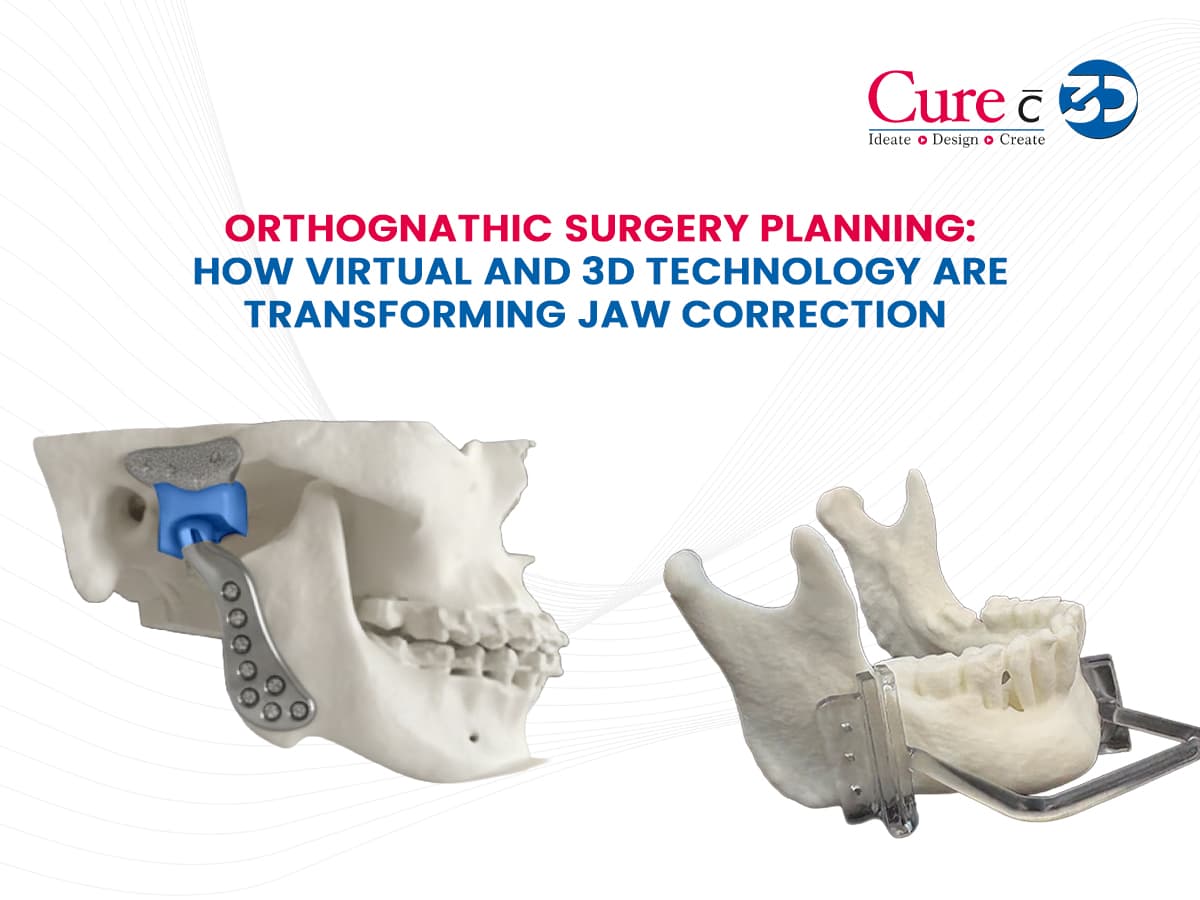
Orthognathic Surgery Planning: How Virtual and 3D Technology Are Transforming Jaw Correction
Corrective jaw surgery has always required exceptional precision. A few millimeters can determine whether a patient achieves proper bite alignment, facial harmony, and long-term stability. For decades, surgeons relied on manual techniques and physical models to plan these complex procedures. Today, orthognathic surgery planning has entered a new era with digital technologies that allow surgeons to visualize, simulate, and perfect surgical outcomes before entering the operating room.
Modern tools such as virtual surgery planning and 3D orthognathic surgery planning are revolutionizing how maxillofacial surgeons approach jaw correction. By combining advanced imaging, digital modeling, and computer simulation, these technologies enable highly accurate surgical planning and improved patient outcomes.
Companies like Curewith3D are playing a crucial role in this transformation by providing advanced digital planning solutions, surgical guides, and patient-specific tools that help surgeons perform orthognathic procedures with greater precision and efficiency.
In this blog, we explore how orthognathic surgery planning has evolved, the role of virtual surgery planning, and how 3D orthognathic surgery planning is shaping the future of jaw surgery.
What is Orthognathic Surgery?
Orthognathic surgery, commonly known as corrective jaw surgery, is a procedure performed to correct structural abnormalities of the jaw and facial bones. These abnormalities can affect both the function and appearance of the face.
Patients may require orthognathic surgery for several reasons, including:
- Severe bite misalignment (malocclusion)
- Facial asymmetry
- Difficulty chewing or speaking
- Chronic jaw pain
- Obstructive sleep apnea
- Congenital jaw deformities
- Jaw growth discrepancies
The procedure typically involves repositioning the upper jaw (maxilla), lower jaw (mandible), or both to achieve proper alignment and facial balance. Orthognathic surgery is usually performed in collaboration between oral and maxillofacial surgeons and orthodontists, who work together to align the teeth and jaws before and after surgery.
However, successful treatment depends heavily on precise orthognathic surgery planning.
Why Orthognathic Surgery Planning is Critical
Corrective jaw surgery is one of the most technically demanding procedures in maxillofacial surgery. Even minor inaccuracies during planning can lead to functional issues or unsatisfactory facial outcomes.
Effective orthognathic surgery planning ensures that surgeons can:
- Achieve proper bite alignment
- Restore facial symmetry
- Improve airway function
- Ensure long-term stability
- Reduce surgical risks
Planning also allows surgeons to determine the exact movements required to reposition the jaw bones. These movements may involve advancing, rotating, or repositioning segments of the jaw by very small yet critical distances.
Without detailed planning, predicting surgical outcomes becomes extremely difficult. That is why modern surgeons increasingly rely on virtual surgery planning and 3D orthognathic surgery planning.
Traditional Methods of Orthognathic Surgery Planning
Before digital technologies became available, orthognathic surgery planning relied on traditional techniques such as:
- 2D Radiographic Analysis: Surgeons analyzed lateral cephalometric X-rays to evaluate jaw relationships and determine surgical movements.
- Plaster Dental Models: Physical dental impressions were used to create plaster models of the patient’s teeth and jaw.
- Manual Surgical Simulation: Surgeons manually repositioned plaster models to simulate jaw movements and fabricate surgical splints.
While these methods were effective for many years, they had several limitations:
- Limited visualization of complex anatomy
- Difficulty predicting three-dimensional changes
- Higher margin of error
- Time-consuming workflows
- Challenges in communication between surgical teams
As surgical expectations increased, these limitations highlighted the need for more advanced planning methods.
What is Virtual Surgery Planning?
Virtual surgery planning (VSP) is a digital approach that allows surgeons to simulate surgical procedures using advanced imaging and computer modeling. The process typically begins with high-resolution imaging, such as CBCT (Cone Beam Computed Tomography) scans and digital dental scans. These images are then converted into detailed 3D anatomical models of the patient’s skull, jaw, and teeth.
Using specialized software, surgeons can perform the entire surgical procedure in a virtual environment. They can reposition jaw segments, evaluate occlusion, and analyze facial symmetry before the actual surgery takes place.
Key features of virtual surgery planning include:
- Digital reconstruction of patient anatomy
- Simulation of jaw movements
- Precise measurement of surgical changes
- Visualization of predicted outcomes
- Collaboration between surgeons and engineers
This digital simulation significantly improves the accuracy and predictability of orthognathic surgery planning.
Understanding 3D Orthognathic Surgery Planning
While virtual planning enables digital simulation, 3D orthognathic surgery planning takes the process even further by integrating advanced modeling and manufacturing technologies.
In 3D planning, the patient’s anatomy is reconstructed into a fully interactive digital model. Surgeons can rotate, analyze, and manipulate the jaw structures from every angle.
The typical workflow of 3D orthognathic surgery planning includes the following steps.
- Image Acquisition – We receive high-resolution CT or MRI scans in DICOM format.
- 3D Anatomical Segmentation – Our engineers convert scan data into a detailed 3D anatomical model of the region of interest.
- Virtual Surgical Planning – We collaborate with the surgeon to plan resections, alignments, and reconstruction goals.
- Patient-Specific Guides & Implant Design – Using advanced CAD software, we design patient-specific guides and implant designs for precise osteotomy and mimic natural anatomy.
- Surgeon Approval – The surgeon reviews and approves the design before manufacturing.
- Additive Manufacturing – We manufacture the model, guides, and implant using precision 3D printing technologies.
- Post-Processing – Implants undergo surface finishing and quality checks.
- Delivery & Surgical Support – The implant is delivered ready for sterilization, along with surgical guides and models, if required.
Through this workflow, 3D orthognathic surgery planning bridges the gap between digital planning and real surgical execution. This streamlined process makes 3D orthognathic surgery planning far more predictable and efficient than traditional methods.
Key Benefits of 3D Orthognathic Surgery Planning
The integration of 3D technologies has transformed the way surgeons approach jaw surgery. Some of the most important advantages include:
- Greater Surgical Precision: Digital planning allows surgeons to measure movements with sub-millimeter accuracy. This level of precision significantly improves surgical outcomes.
- Predictable Results: By performing the surgery virtually beforehand, surgeons can visualize the final facial appearance and bite alignment before the operation.
- Improved Surgical Efficiency: With detailed planning and pre-fabricated surgical guides, the surgical workflow becomes faster and more efficient.
- Enhanced Communication: 3D models help surgeons communicate treatment plans clearly with orthodontists, surgical teams, and patients.
- Better Patient Understanding: Patients can see a visual simulation of how their facial structure will change after surgery, which increases confidence and satisfaction.
Technologies Used in Modern Orthognathic Surgery Planning
Several advanced technologies power modern orthognathic surgery planning.
- CBCT Imaging – Cone Beam CT scans provide highly detailed 3D imaging of craniofacial structures with lower radiation compared to conventional CT.
- CAD/CAM Technology – Computer-Aided Design and Manufacturing enables the creation of precise surgical splints and guides.
- 3D Printing – Custom surgical guides and splints are fabricated using advanced additive manufacturing techniques.
- Artificial Intelligence – AI-driven tools are increasingly assisting surgeons in analyzing anatomical data and predicting surgical outcomes.
- Digital Dental Scanning – Intraoral scanners capture highly accurate digital impressions of the patient’s teeth.
Together, these technologies make virtual surgery planning and 3D orthognathic surgery planning more powerful and reliable than ever before.
The Role of Curewith3D in Orthognathic Surgery Planning
As digital surgical planning continues to advance, specialized companies are helping surgeons adopt these technologies more easily.
Curewith3D provides advanced solutions for orthognathic surgery planning, enabling surgeons to perform complex procedures with greater precision and efficiency.
The Curewith3D workflow combines clinical expertise with digital engineering to deliver highly accurate surgical planning support.
Services typically include:
- Advanced virtual surgery planning
- Customized 3D orthognathic surgery planning
- Patient-specific surgical splints
- Custom surgical cutting guides
- Digital collaboration with surgical teams
By working closely with surgeons, Curewith3D helps translate digital surgical plans into practical tools that improve real-world surgical outcomes.
This collaborative approach ensures that surgeons can focus on clinical decisions while benefiting from advanced digital planning technologies.
The Future of Orthognathic Surgery Planning
The field of orthognathic surgery continues to evolve rapidly as digital technologies advance.
Future developments may include:
- AI-powered surgical planning platforms
- Real-time surgical navigation systems
- Patient-specific implants
- Robotic-assisted jaw surgery
- Augmented reality surgical visualization
These innovations will further enhance the accuracy, safety, and predictability of orthognathic surgery planning.
As digital planning becomes the new standard, technologies like virtual surgery planning and 3D orthognathic surgery planning will continue to play a central role in modern maxillofacial surgery.
In Conclusion
Corrective jaw surgery demands exceptional precision, careful planning, and multidisciplinary collaboration. Traditional planning methods served surgeons well for many years, but modern digital technologies have dramatically improved the accuracy and predictability of surgical outcomes.
Today, orthognathic surgery planning is increasingly powered by advanced tools such as virtual surgery planning and 3D orthognathic surgery planning. These technologies enable surgeons to simulate procedures, design custom surgical guides, and perform operations with unparalleled accuracy.
Through innovative digital solutions, Curewith3D is helping surgeons adopt these advanced planning methods and deliver better outcomes for patients undergoing complex jaw correction procedures.
As technology continues to evolve, the future of orthognathic surgery will become even more precise, personalized, and efficient.
FAQs
What is orthognathic surgery planning?
Orthognathic surgery planning is the process of analyzing jaw anatomy and determining the precise surgical movements required to correct jaw alignment. It ensures that surgeons can achieve accurate bite correction and facial balance during corrective jaw surgery.
What is virtual surgery planning in orthognathic surgery?
Virtual surgery planning uses digital imaging and computer software to simulate jaw surgery before the actual procedure. Surgeons can reposition jaw segments, analyze bite relationships, and predict surgical outcomes in a virtual environment.
How does 3D orthognathic surgery planning improve surgical accuracy?
3D orthognathic surgery planning provides a detailed three-dimensional model of the patient’s anatomy. This allows surgeons to measure jaw movements precisely, design custom surgical guides, and replicate the surgical plan accurately during the procedure.
What technologies are used for orthognathic surgery planning?
Modern orthognathic surgery planning may involve:
- CBCT imaging
- Digital dental scanning
- Virtual surgery planning software
- CAD/CAM design tools
- 3D printing for surgical guides
These technologies improve precision and efficiency.
How can Curewith3D support orthognathic surgery planning?
Curewith3D provides advanced virtual surgery planning and 3D orthognathic surgery planning services. The company helps surgeons create precise surgical plans, design patient-specific guides, and streamline the surgical workflow for better clinical outcomes.