
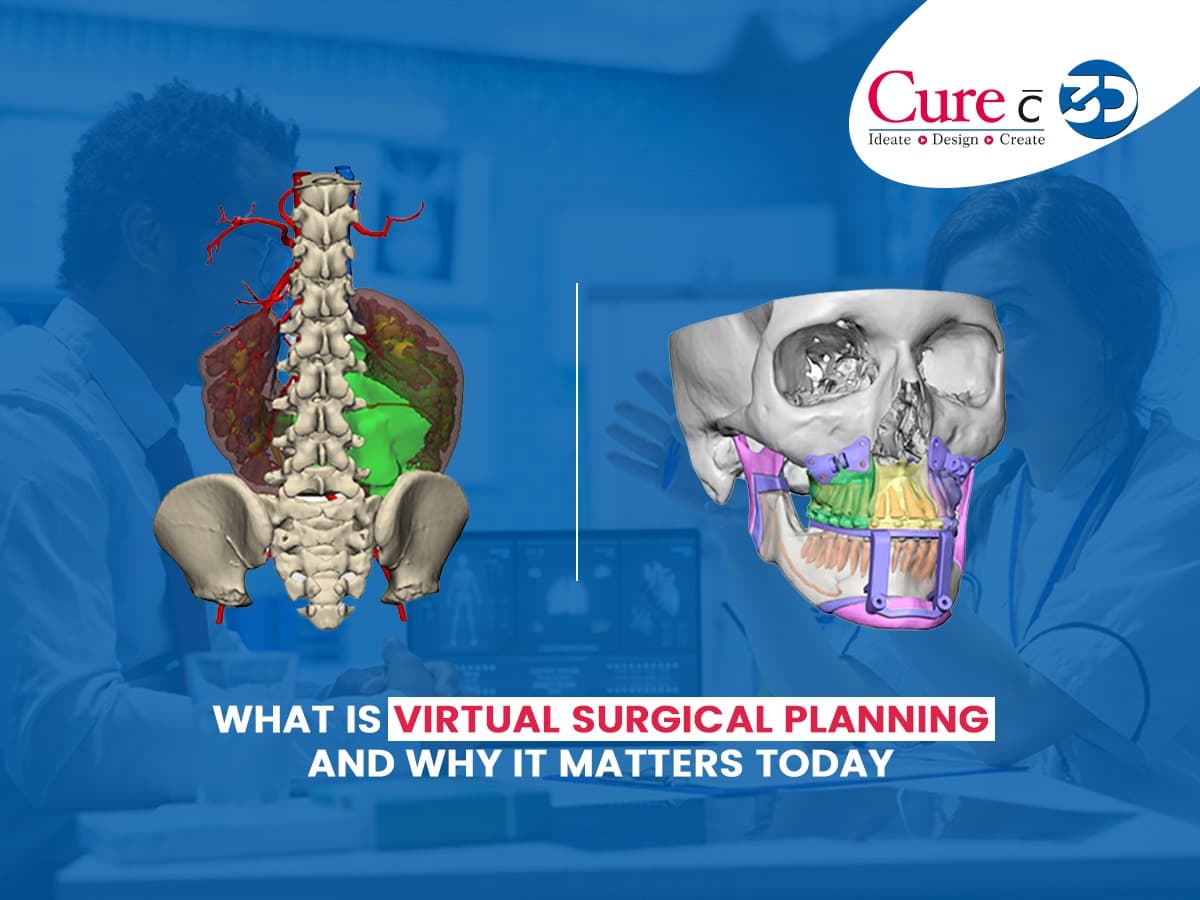
What is Virtual Surgery Planning and Why it Matters Today
Modern surgery is no longer just about skill in the operating room; it’s about precision before the first incision. For decades, surgeons relied on 2D scans, physical models, and experience-driven judgment. While effective, those methods left room for uncertainty.
Today, that uncertainty is shrinking—fast.
Virtual surgery planning (VSP) is transforming how surgeons prepare, predict, and perform complex procedures. It brings clarity to what was once estimated, turning surgical planning into a data-driven, highly visual process. From jaw corrections to trauma reconstruction, this approach is redefining outcomes.
So what exactly is virtual surgery planning, and why is it becoming essential in modern healthcare? Let’s break it down.
What is Virtual Surgery Planning?
At its core, virtual surgery planning is a digital method that allows surgeons to plan procedures in a 3D environment before entering the operating room.
Instead of imagining outcomes based on flat images, surgeons can:
- View the patient’s anatomy in three dimensions
- Simulate surgical steps
- Predict post-surgical results
This process uses advanced imaging data such as CBCT scans, intraoral scans, and facial scans. These are combined to create a highly accurate digital model of the patient.
Think of it as a “test run” of the surgery, which is done virtually, without any risk to the patient.
What makes VSP powerful is not just visualization, but precision. Surgeons can measure movements in millimeters and plan every step in advance.
How Virtual Surgery Planning Works
While the technology behind VSP is advanced, the workflow is structured and intuitive.
Here’s how it typically unfolds:
- Data Collection: Everything starts with high-quality imaging CBCT (Cone Beam CT) scans, 3D facial scans, and intraoral scans. These inputs capture both hard and soft tissue details.
- 3D Reconstruction: The collected data is converted into a digital 3D model. This model represents the patient’s exact anatomy: bones, teeth, and facial structure.
- Surgical Simulation: This is where the real value appears. Surgeons can perform virtual cuts (osteotomies), reposition bones, and adjust alignment. They can test multiple approaches and choose the most effective one, all before surgery day.
- Design of Surgical Tools: Once the plan is finalized, surgical guides, splints, and patient-specific implants are designed using CAD technology and often manufactured through 3D printing.
- Pre-Surgical Validation: Before the actual procedure, the entire plan is reviewed and validated. This ensures that what was planned digitally translates accurately in the operating room.
The Role of Virtual Planning in Orthognathic Surgery
One of the biggest breakthroughs of VSP is in orthognathic surgery planning, a procedure that corrects jaw misalignment.
Traditionally, these surgeries involved:
- Manual model surgery
- Facebow transfers
- Time-consuming lab work
Now, 3D orthognathic surgery planning has streamlined the process.
Why It Matters in Jaw Surgery
Jaw alignment is complex. Even a small miscalculation can affect:
- Facial symmetry
- Bite function (occlusion)
- Speech and breathing
With virtual planning:
- Surgeons can move the jaw in all three planes (X, Y, Z)
- Facial outcomes can be previewed
- Occlusion can be optimized before surgery
This leads to more predictable and balanced results.
Traditional vs Virtual Surgical Planning
The shift from traditional methods to VSP is not just an upgrade; it’s a complete transformation.
| Traditional Planning | Virtual Surgery Planning |
| Based on 2D X-rays | 3D, fully interactive models |
| Physical plaster models | Real-time simulation |
| Limited visualization | Precise measurements |
| Higher margin for error | Better coordination between surgical teams |
In simple terms, traditional planning relies on approximation, while VSP is built on accuracy.
Key Benefits of Virtual Surgery Planning
The growing adoption of VSP is driven by clear, measurable advantages.
- Exceptional Accuracy: Virtual tools allow movements as precise as fractions of a millimeter. This is critical in delicate procedures like jaw or facial surgery.
- Predictable Outcomes: Surgeons and patients can visualize expected results before surgery. This reduces uncertainty and builds confidence.
- Reduced Surgical Time: When every step is pre-planned, the procedure becomes more efficient. Shorter surgeries often mean lower anesthesia time and faster recovery.
- Better Patient Communication: Showing a patient a 3D simulation is far more effective than explaining with words alone. It improves understanding and trust.
- Personalized Treatment: No two patients are the same. VSP enables fully customized solutions, including patient-specific implants.
- Improved Functional and Aesthetic Results: Especially in facial and jaw surgeries, outcomes depend on both function and appearance. VSP helps balance both.
Where Virtual Surgery Planning is Used
While orthognathic procedures are a major application, VSP is widely used across specialties:
- Orthognathic (jaw) surgery
- Craniofacial reconstruction
- Trauma surgery (fractures, defects)
- Dental implant planning
- Cosmetic facial procedures
For example, in trauma cases, surgeons can digitally reconstruct damaged structures before operating, thereby saving critical time during surgery.
Challenges and Limitations
Despite its advantages, VSP is not without challenges.
- Learning Curve: Surgeons must adapt to digital workflows and collaborate with engineers or planning specialists.
- Cost Considerations: Advanced imaging and planning tools can increase upfront costs, though they often reduce overall treatment costs by improving efficiency.
- Dependence on Data Quality: Accurate planning depends on high-quality scans. Poor imaging can affect results.
- Collaboration Requirements: Successful VSP often involves teamwork between surgeons, designers, and technicians.
These limitations are real, but they are steadily decreasing as technology becomes more accessible.
Why Virtual Surgery Planning Matters Today
Healthcare is evolving, and so are patient expectations.
Today’s patients want:
- Safer procedures
- Faster recovery
- Predictable results
At the same time, surgeons are handling more complex cases than ever before.
Virtual surgery planning bridges this gap.
It matters today because it:
- Reduces surgical risks
- Improves precision in complex procedures
- Enhances overall patient outcomes
- Supports minimally invasive approaches
In many advanced centers, VSP is no longer optional—it’s becoming the standard.
The Future of Virtual Surgical Planning
The future of VSP looks even more promising.
Emerging innovations include:
- AI-driven planning for faster and smarter simulations
- Augmented reality (AR) in operating rooms
- Real-time surgical navigation systems
- More advanced patient-specific implants
As these technologies evolve, the line between planning and execution will become even more seamless.
Why Curewith3D Stands Out in Virtual Surgery Planning
In a field that demands precision, experience, and innovation, Curewith3D brings all three together.
The focus is not just on technology, but on delivering:
- Accurate, patient-specific planning
- Seamless collaboration with surgeons
- High-quality 3D models and surgical guides
By combining advanced tools with clinical understanding, Curewith3D helps turn complex surgical challenges into predictable outcomes.
Conclusion: Precision Starts Before Surgery
Surgery no longer begins in the operating room—it begins on a screen. Virtual surgery planning has changed the way procedures are approached, especially in complex areas such as orthognathic surgery and 3D orthognathic surgery. It replaces uncertainty with clarity. It replaces estimation with accuracy. Most importantly, it improves outcomes for both surgeons and patients. As healthcare continues to move toward personalized and precision-driven care, VSP is not just a trend—it’s the future.
If you’re a surgeon or healthcare provider looking to enhance surgical outcomes, now is the time to adopt virtual planning solutions.
FAQs
What is virtual surgery planning in simple terms?
Virtual surgery planning is a digital process where surgeons plan and simulate procedures using 3D models before performing the actual surgery.
How does 3D orthognathic surgery planning improve results?
It allows precise jaw movements in all directions, improving facial symmetry, bite alignment, and overall outcomes.
Is virtual surgery planning accurate?
Yes, it offers highly accurate measurements, often within sub-millimeter precision, making it more reliable than traditional methods.
Who should consider orthognathic surgery planning with VSP?
Patients with jaw misalignment, facial asymmetry, or bite issues can benefit significantly from virtual planning.
Does virtual surgery planning reduce surgery time?
Yes, because the procedure is pre-planned in detail, surgeons can perform operations more efficiently, reducing overall time.