
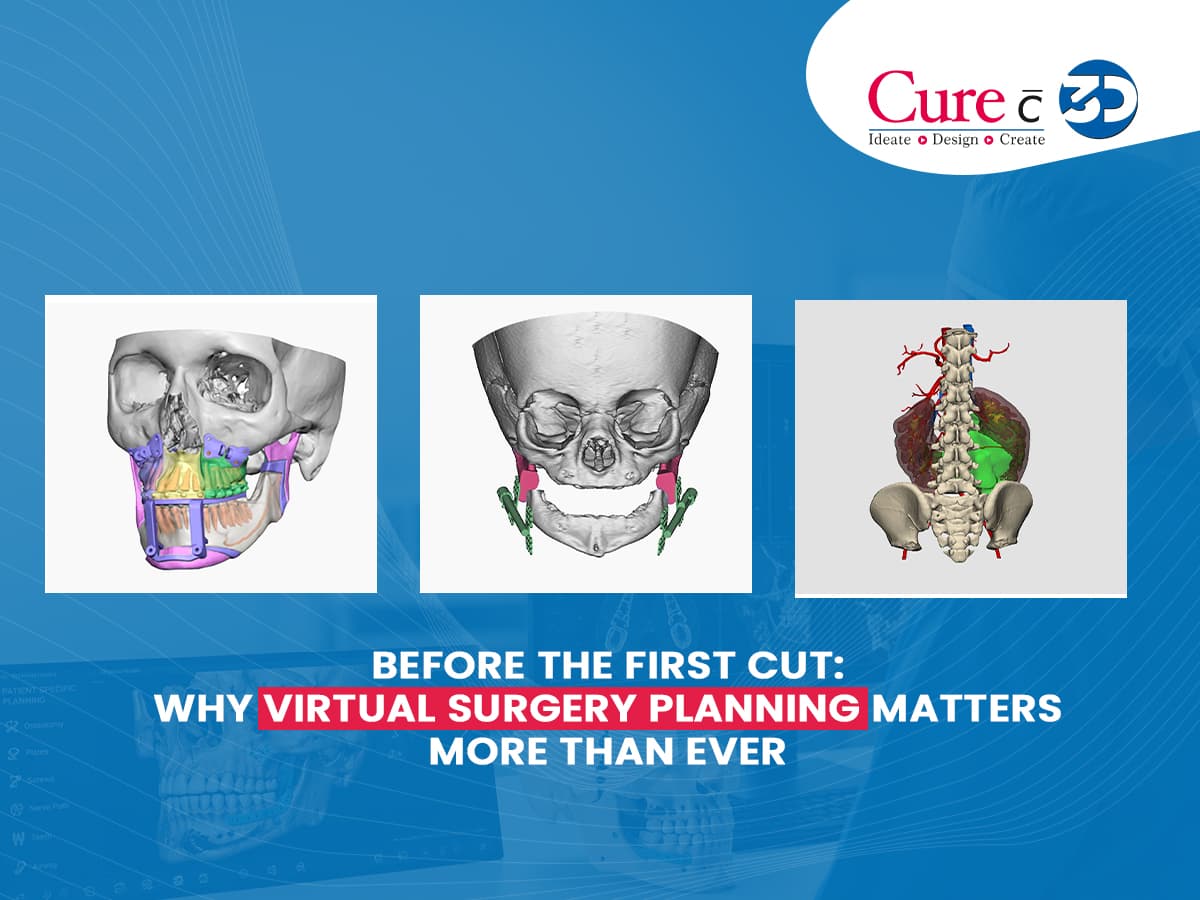
Before the First Cut: Why Virtual Surgery Planning Matters More Than Ever
Surgery is no longer just about skill; it’s about preparation. Today, the difference between a good outcome and a great one often comes down to how well a procedure is planned before the first incision is made.
This is where virtual surgery planning (VSP) is changing the game.
Instead of relying only on 2D scans or mental visualization, surgeons can now explore a patient’s anatomy in 3D, simulate procedures, and even practice complex steps before entering the operating room. Add to that the power of 3D surgical models, pre-surgical planning models, and anatomical model printing, and you get a level of precision that simply wasn’t possible a decade ago.
For healthcare providers and innovators like Curewith3D, this isn’t just technology; it’s a smarter, safer way to approach surgery.
What is Virtual Surgery Planning?
Virtual surgery planning is a digital process that allows surgeons to plan, simulate, and optimize surgical procedures using patient-specific data.
It starts with imaging, like CT or MRI scans, and converts those into detailed 3D representations of the patient’s anatomy. These models are then used to:
- Visualize complex structures
- Map out surgical approaches
- Predict potential challenges
- Improve decision-making before surgery begins
Think of it as a rehearsal, but for real-life surgery.
Instead of figuring things out during the procedure, surgeons walk in with a clear, tested plan.
How Virtual Surgery Planning Works
Behind every successful VSP case is a structured workflow. Each step builds toward accuracy and predictability.
1. Data Acquisition
Everything starts with high-quality imaging.
- CT scans for bones and dense structures
- MRI for soft tissues
- CBCT for dental and craniofacial cases
The better the scan, the more precise the outcome.
2. 3D Reconstruction
Next, the imaging data is converted into a digital 3D model.
This is where raw scans turn into something usable. Engineers and specialists segment the anatomy, separating bones, tissues, and organs into clear structures.
This step forms the foundation for both pre-surgical planning models and 3D surgical models.
3. Virtual Simulation
Now comes the real advantage.
Surgeons can:
- Test different surgical approaches
- Simulate cuts, alignments, or implant placements
- Identify risks before they happen
This isn’t guesswork; it’s calculated planning.
4. Anatomical Model Printing
Digital models are powerful. Physical ones take it further.
Through anatomical model printing, surgeons get a tangible, patient-specific replica. They can hold it, study it, and even use it during surgery.
These models are especially useful in:
- Complex fractures
- Tumor resections
- Reconstructive procedures
5. Surgical Execution
With everything planned and tested, surgery becomes more controlled.
Surgeons often use:
- Patient-specific guides
- Custom implants
- Pre-determined cutting paths
The result? Fewer surprises and better outcomes.
The Role of 3D Surgical Models in Modern Surgery
3D surgical models are at the heart of virtual surgery planning.
They provide something traditional imaging cannot, that is, true spatial understanding.
Why They Matter
- They reveal complex anatomy in a simple way
- They reduce interpretation errors
- They improve surgical confidence
For example, in craniofacial surgery, even a few millimeters matter. A 3D model helps surgeons see exactly where to cut and how to reconstruct.
Digital vs Physical Models
Both have their place:
- Digital models are ideal for simulations and planning
- Physical models are better for hands-on analysis and intraoperative guidance
Together, they create a complete planning ecosystem.
What are Pre-Surgical Planning Models?
Pre-surgical planning models are customized 3D representations created specifically to prepare for a procedure.
Unlike generic anatomical diagrams, these models are:
- Patient-specific
- Highly detailed
- Procedure-focused
Where They’re Used
These models are widely used across specialties:
- Orthopedics – fracture alignment, joint replacement
- Maxillofacial surgery – jaw reconstruction, facial symmetry
- Cardiac surgery – understanding congenital defects
- Oncology – tumor localization and safe removal
They bridge the gap between diagnosis and execution.
What are the Benefits of Virtual Surgery Planning
The real value of VSP shows up in results. It improves not just how surgeries are done, but how patients recover.
- Greater Surgical Accuracy: Planning reduces guesswork. Surgeons know exactly what to do before they begin.
- Reduced Operation Time: When steps are pre-defined, procedures become faster. That means less time under anesthesia and lower risk.
- Personalized Treatment: Every patient is different. VSP ensures the treatment matches the individual anatomy and not a standard template.
- Better Patient Outcomes: More precision leads to fewer complications, faster recovery, and improved functional & aesthetic results.
- Improved Communication: 3D models make it easier to explain procedures to patients, surgical teams, and medical students.
When everyone understands the plan, execution improves.
Applications Across Medical Specialties
Virtual surgery planning is not limited to one field. Its impact is widespread.
- Orthopedics: Used for joint replacements, trauma cases, and deformity correction. Surgeons can pre-plan implant placement with high precision.
- Maxillofacial Surgery: One of the earliest adopters. Helps in jaw alignment, reconstructive surgeries, and facial symmetry corrections.
- Neurosurgery: Used to navigate delicate brain structures and plan tumor removal with minimal damage.
- Cardiac Surgery: Helps visualize complex heart defects and plan interventions more safely.
- Oncology: Supports tumor mapping and ensures maximum removal while preserving healthy tissue.
Virtual Surgery Planning vs Traditional Planning
Let’s be honest—traditional planning has its limits.
| Feature | Traditional Planning | Virtual Surgery Planning |
| Visualization | 2D scans | 3D interactive models |
| Accuracy | Moderate | High |
| Customization | Limited | Fully patient-specific |
| Predictability | Uncertain | Highly predictable |
The shift isn’t just technological; it’s fundamental.
Challenges and Limitations
While powerful, virtual surgery planning isn’t without challenges.
- Cost Considerations: Advanced imaging, software, and printing can be expensive. However, the long-term benefits often outweigh the initial cost.
- Skill Requirements: It requires collaboration between surgeons, radiologists, and engineers. Not every facility has that ecosystem yet.
- Data Dependency: Accuracy depends heavily on imaging quality. Poor scans lead to less reliable models.
- Integration Issues: Some hospitals still rely on traditional workflows, making adoption slower.
The Future of Virtual Surgery Planning
The next phase of virtual surgery planning is even more exciting.
- AI Integration: Artificial intelligence will help automate planning and suggest optimal surgical approaches.
- AR and VR: Surgeons may soon “step inside” a patient’s anatomy using immersive technology.
- Automation: From model creation to surgical guides, processes will become faster and more scalable.
- Wider Accessibility: As technology becomes more affordable, adoption will grow—especially in developing healthcare systems.
Why Virtual Surgery Planning Matters More Than Ever
Healthcare is moving toward personalization. Patients expect better outcomes, shorter recovery times, and fewer risks.
Virtual surgery planning delivers on all three.
It transforms surgery from a reactive process into a proactive one.
Instead of adapting during the procedure, surgeons walk in prepared.
Conclusion: A Smarter Way to Plan Surgery
Virtual surgery planning is not just an upgrade; it’s a shift in how surgery is approached. By combining 3D surgical models, pre-surgical planning models, and anatomical model printing, healthcare providers can achieve a level of precision that directly improves patient outcomes.
For innovators like Curewith3D, this technology is more than a service; it’s a commitment to better, safer, and more predictable surgical care.
If you’re looking to bring accuracy, efficiency, and confidence into surgical workflows, now is the time to explore virtual surgery planning.
The future of surgery isn’t just in the operating room—it starts long before it.
FAQs
What is virtual surgery planning used for?
Virtual surgery planning is used to simulate and plan surgical procedures using patient-specific 3D models. It helps improve accuracy, reduce risks, and enhance outcomes.
How accurate are 3D surgical models?
3D surgical models are highly accurate when created from high-resolution imaging like CT or MRI scans. They closely replicate patient anatomy and support precise planning.
What is anatomical model printing?
Anatomical model printing is the process of creating physical 3D replicas of patient anatomy using medical imaging data. These models help in surgical planning and education.
Are pre-surgical planning models necessary for all surgeries?
Not all surgeries require them, but they are extremely valuable in complex or high-risk procedures where precision is critical.
How long does virtual surgery planning take?
The process can take anywhere from a few hours to a few days, depending on the complexity of the case and the level of detail required.